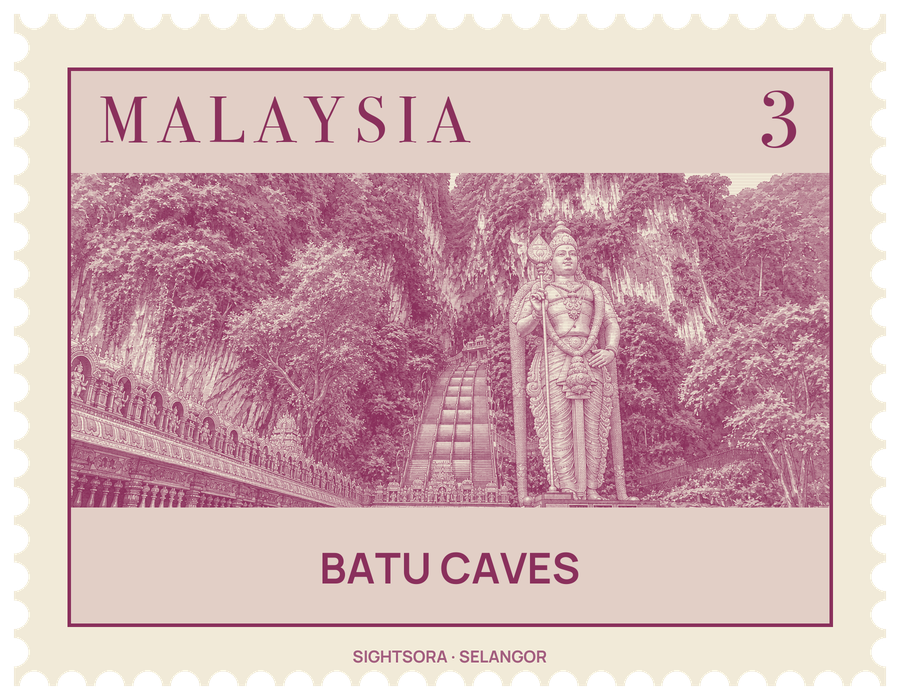
Beside the foot of the stairs stands a gold-painted statue of Murugan about 43 metres tall, unveiled in January 2006. The hill itself is a 325-metre mogote, and the name comes from the Malay word batu, meaning rock; in Tamil the complex is known as Pathu Malai.
Long before the temples, the Temuan, one of the Orang Asli peoples, sheltered in these caves, and from the 1860s Chinese settlers dug guano out of them for fertiliser. K. Thamboosamy, a Tamil trader, promoted the site as a place of Hindu worship; the story goes that the shape of the cave mouth, like the vel, the spear carried by Murugan, inspired him to found a temple. The Murugan shrine was finished in 1891, and the first Thaipusam festival was held the following year. Pilgrims at first scrambled up the hillside, then used wooden steps from 1920, until the concrete stairway was built in 1940; in 2018 its sections were painted in different colours.
The Subramanian Swamy temple fills the largest cave, a high limestone chamber hung with stalactites. Smaller sites cluster at the base of the hill. The Art Gallery Cave and the Museum Cave, together called the Cave Villa, hold statues and paintings from Hindu mythology, most about the life of Murugan. Off to the left, the Ramayana Cave is painted with scenes from the Ramayana epic, and a 15-metre statue of Hanuman guards its entrance next to a temple to Hanuman opened in 2001.
Batu Caves is the centre of Thaipusam in Malaysia, the yearly festival of Tamil Hindus, which draws thousands of people. The procession sets out in the morning from the Sri Mahamariamman Temple in Kuala Lumpur behind a 350-kilogram silver chariot carrying images of Murugan and his consorts Valli and Deivanai. Devotees bathe in the Sungai Batu river and then climb to the temple carrying kavadi, burdens balanced on the shoulders, or pots of milk as offerings; some pierce their skin, cheeks or tongues with skewers and enter a trance to the sound of drums and chanting.
The hill is a rich natural habitat as well as a shrine. Around 269 species of vascular plants have been recorded here, along with 21 species of bats and a trapdoor spider, Liphistius batuensis, found nowhere else. Long-tailed macaques live around the temple steps and are used to taking food from people. On the north-eastern side, at the Damai caves, nearly 160 rock-climbing routes run up cliffs as high as 150 metres.
Getting there
Commuter trains run from KL Sentral in Kuala Lumpur to Batu Caves Komuter station. Bus 11 runs from the Bangkok Bank stop near Central Market.