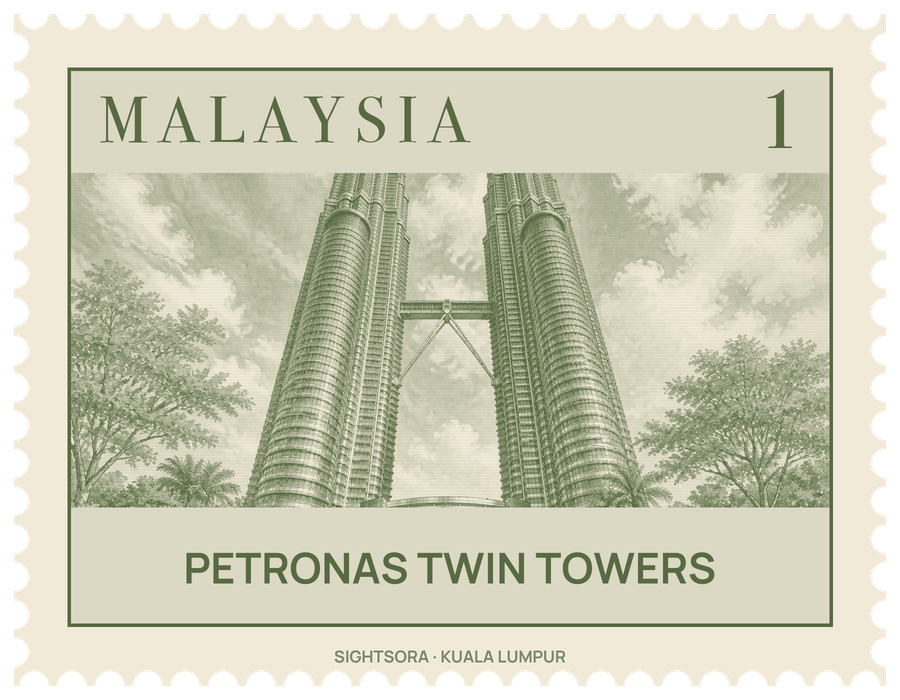
They were designed by the Argentine-American architect César Pelli in a postmodern style, and they can be seen from many parts of the city, alongside the Kuala Lumpur Tower and Merdeka 118. The Prime Minister, Mahathir bin Mohamad, opened them officially on 31 August 1999.
The design borrows from Islamic art. Each tower's floor plan is built on the Rub el Hizb, an eight-pointed star, with rounded sections added between the points to make room for offices, and the patterning of the façade echoes motifs from the same tradition. Under the cladding the towers are mostly reinforced concrete rather than steel, carried by large concrete cores and a ring of widely spaced columns, which leaves the office floors free of internal pillars.
The site was once Kuala Lumpur's race track, the grounds of the Selangor Turf Club. Excavation began in 1993, and test drilling showed that half the plot was decayed limestone, so the whole footprint was shifted 61 metres onto soft rock. Each tower rests on a concrete raft 4.6 metres thick, poured without a break over 54 hours, above concrete piles driven 60 to 114 metres into the ground. To finish on the government's schedule, two consortia built the towers at the same time: a Japanese group led by Hazama put up Tower 1 on the west, and a South Korean group led by Samsung built Tower 2 on the east.
The skybridge, 58.4 metres long, crosses between the towers at floors 41 and 42, some 170 metres above the street. A two-hinged arch with legs bolted to the 29th floor of each tower holds it up; it was assembled on the ground and lifted into position over three days in July 1995. Besides letting people cross between the towers, it serves as an escape route if one tower has to be emptied. Visitors can walk across it, and the tour continues upward to level 86, where an observation deck in Tower 2 looks out over the city.
At the foot of the towers is Suria KLCC, a shopping centre of around 300 stores with an art gallery, an underwater aquarium and a science centre, and the Petronas Philharmonic Hall, home of the Malaysian Philharmonic Orchestra. Beyond it lies the 6.9-hectare KLCC Park, laid out with walking and jogging paths, wading pools, a children's playground and a fountain that comes with a light show.