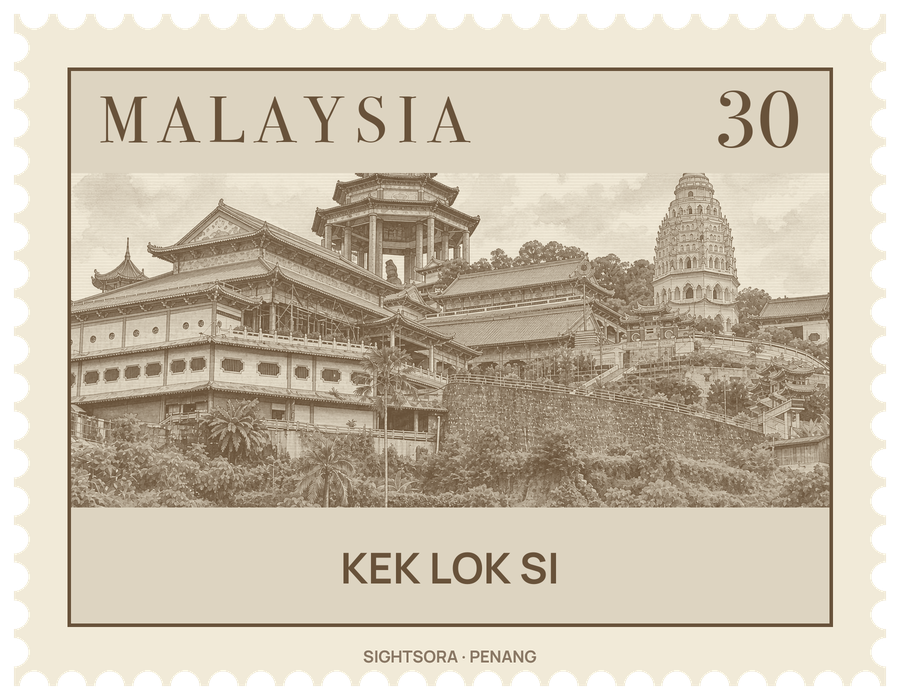
The name, in Hokkien, means "supreme joy", a rendering of the Sanskrit Sukhāvatī, the Pure Land. It is a major place of pilgrimage for Buddhists from Singapore, Hong Kong, the Philippines and other parts of Southeast Asia.
The temple was the idea of Beow Lean, a Chan Buddhist monk from the Goddess of Mercy Temple on Pitt Street, who chose this site in the hills facing the sea and became its first abbot. Work started in 1890, the first complex was finished in 1905, and the building went on until 1930. Five Hakka business leaders of Penang, among them Cheong Fatt Tze, paid for the halls. In 1904 the Guangxu Emperor received Beow Lean in Beijing and gave him a great collection of Buddhist scriptures, along with edicts that placed the temple above every other Chinese temple in Penang.
The Pagoda of the Ten Thousand Buddhas, or Ban Po Thar, was completed in 1930 and stands 30 metres high. King Rama VI of Thailand laid its foundation, which is why it is also called the Rama Pagoda, and its design sets a Chinese octagonal base below a Thai middle tier and a Burmese spiral crown, a mix of Mahayana and Theravada traditions in one building. Inside are thousands of Buddha statues in alabaster and bronze.
Higher up the hill, the bronze Guanyin, the Goddess of Mercy, was completed in 2002 to replace an earlier white plaster statue damaged by fire. A pavilion 60.9 metres high with a three-tiered roof on 16 bronze columns shelters her, and a hundred smaller Guanyin statues, each 2 metres tall, stand around the main figure. Two tiers of inclined lifts carry visitors up the slope, with an electric buggy linking them, and a fish pond lies on the upper platform.
Most visitors arrive up a covered stairway lined with shops selling religious goods and souvenirs, passing the Liberation Pond, where turtles are released as an act of merit. Inside, the halls hold gilded statues of Buddhas, Bodhisattvas, Lohans and guardian kings, with carved pillars, brightly painted woodwork, lanterns and a large hydraulic bell. For 30 days after Chinese New Year the temple stays open late, and thousands of lights and lanterns donated by devotees cover the complex.
Getting there
The temple is about 3 kilometres on foot from the Penang Hill Station.