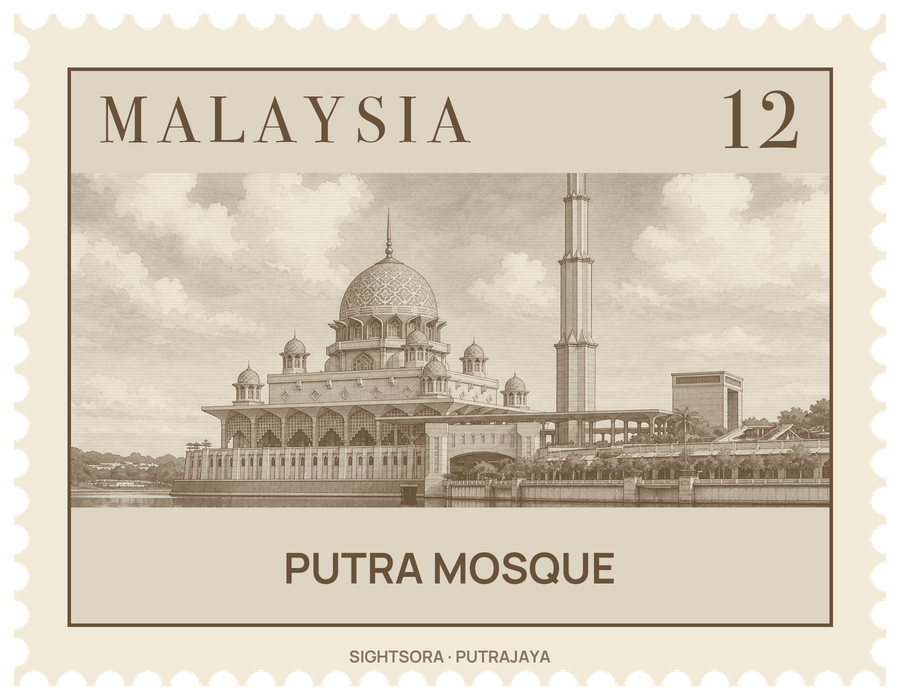
It is the principal mosque of Putrajaya, the administrative capital Malaysia developed in the mid-1990s, and it carries the name of the country's first prime minister, Tunku Abdul Rahman Putra al-Haj.
Work began in 1997 and took two years. The architect, Dato' Dr. Nik Mohamed Mahmood, drew on traditional Malay building as well as Safavid, Moorish and Mamluk sources, the last of these visible in the arches, with arabesque ornament on the dome. The complex spreads over 1.37 hectares and can take 15,000 worshippers at a time; its Sahn, the courtyard ringed by colonnades and water features, holds up to 5,000 people at congregations.
Nine domes crown the mosque: the main one, 35 metres high and 50 metres across, and eight more set around it at the corners. Inside, honeycomb vaulting carved at the four corners of the main dome catches the light through tiny mirrors, and stained glass windows circle its base. The minaret rises 116 metres in five tiers standing for the Five Pillars of Islam, a stepped form modelled on the layered bevelling of Baghdad's 12th-century Sheikh Omar Mosque.
In the prayer hall, the mihrab, the niche that marks the direction of prayer, is covered with calligraphy of inscriptions from the Quran and with tilework, and the minbar from which the imam preaches stands to its right. Doors, windows and panels are carved in cengal wood, and the basement walls were modelled on Morocco's King Hassan Mosque. Its rooms are also used for conferences, seminars and exhibitions.
Getting there
KLIA Transit trains run from KL Sentral to Putrajaya & Cyberjaya Station, and the mosque is a short ride on from there by taxi or ride-hailing car. Buses link Terminal Bersepadu Selatan with Putrajaya Sentral, and drivers can come by the MEX Expressway.