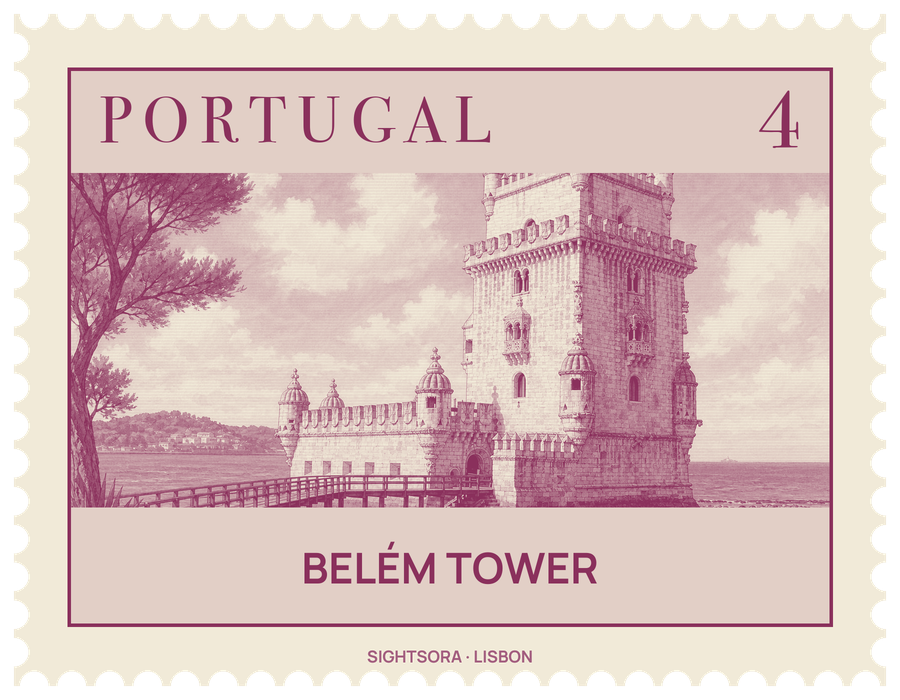
It pairs a low bastion pushing south into the river with a four-storey tower about 30 metres tall, and its carved stonework makes it a prominent example of the Manueline style. Officially named the Tower of Saint Vincent after Lisbon's patron saint, it has been a UNESCO World Heritage Site together with the nearby Jerónimos Monastery since 1983.
King John II had wanted a strong fort to close the mouth of the Tagus, but died before plans were drawn; Manuel I took up the idea and gave the job to Francisco de Arruda, a military architect with fortress work in Morocco behind him, who raised it on a basalt outcrop just off the shore. It was finished in 1519. Contrary to a story often repeated, the 1755 earthquake did not shift the river away from it: it was built on a small island near the bank, and the shoreline slowly crept out to meet it. In 1580 its garrison surrendered to Spanish forces after a few hours, and its dungeons then held prisoners until 1830, among them the liberal opponents of King Miguel I. It also served as a customs post for ships entering the harbour, and was restored in the 1840s and again in 1997–1998.
The outside reads as a catalogue of Manueline symbols tied to the sea: carved twisted rope and knots, armillary spheres from Manuel I's banner, and the cross of the Order of Christ, of which the king was a member, repeated on shields around the parapets. Small watchtowers with ribbed domes sit at the corners of the bastion, showing a Moorish influence also seen in the arched windows and balconies. Look at the base of one of these turrets for the carved rhinoceros, which probably shows the beast the king shipped to Pope Leo X in 1515. The lower bastion has openings for 17 cannons facing the river.
Visitors reach the tower over a small bridge from the far western stretch of Avenida de Brasília and enter through a drawbridge gate decorated with the royal coat of arms. Inside the bastion are the vaulted gun casemate, whose side storerooms were later used as prison cells, and above it an open cloister that was designed to let cannon smoke escape; on its southern side stands a statue of the Virgin holding a child and a bunch of grapes. A spiral staircase climbs through the tower: the octagonal Governor's Hall, the Sala dos Reis opening onto a seven-arched loggia above the river, the Sala das Audiências, and a chapel with a ribbed vault on the top floor, crowned by a terrace with views over the surrounding landscape.