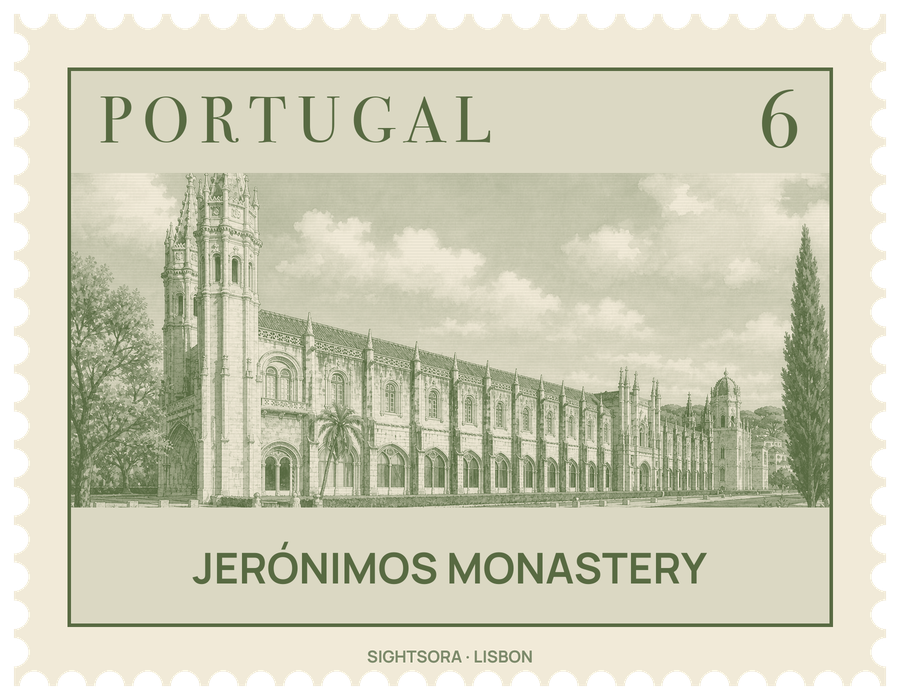
Built for monks of the Order of Saint Jerome, it is a prominent example of the ornate Manueline style, with carved ropes, armillary spheres and sea motifs, and it holds the tombs of kings, of da Gama himself and of the poet Luís de Camões. Since 1983 it has been a UNESCO World Heritage Site together with the nearby Tower of Belém.
Manuel I wanted a burial place for his dynasty, the House of Aviz, on the site of an older seafarers' church at Restelo, where da Gama and his crew spent the night in prayer before leaving for India in 1497. Work started on 6 January 1501, paid for largely by a 5 percent tax on trade with Africa and the East, and took a century to finish. Diogo de Boitaca drew the plans in a gold-coloured lioz limestone; the Spaniard Juan de Castillo took over around 1517 and moved towards the Plateresque, and later Diogo de Torralva and Jérôme de Rouen added Renaissance and classical work. The Hieronymite monks prayed for the king's soul and looked after departing sailors until the religious orders were dissolved in 1833. The monastery survived the 1755 earthquake with little damage, and in 2007 the Treaty of Lisbon was signed here.
Two portals are worth studying from outside. The great south portal by Juan de Castillo, 32 metres high, is a crowd of gables, pinnacles and statues in canopied niches, with Henry the Navigator on a pedestal between the two doors and scenes from Saint Jerome's life above; despite its size it is a side door. The smaller west portal, carved by Nicolau Chanterene in 1517 and facing the main altar, is the more important entrance: its tympanum shows the Annunciation, the Nativity and the Epiphany, and statues of Manuel I and Queen Maria of Aragon kneel at either side under their patron saints.
Inside, the Church of Santa Maria is a hall church whose three aisles rise to the same height under one ribbed vault 19 metres across. Castillo carried the vault on six slender octagonal columns 25 metres high, dressed in Renaissance grotesques, and the transept vault spans the space with no piers at all, so it seems to hang in the air. The chancel, by Jerónimo de Ruão, holds royal tombs set on marble elephants: Manuel I and Maria of Aragon on the left, João III and Catherine of Austria on the right. Vasco da Gama and Camões lie in neo-Manueline stone tombs carved by Costa Mota, to which their remains were moved in 1880.
The two-storey cloister, 55 metres on each side, is the monastery's other high point. Boitaca began it with wide arches and fine tracery, and Castillo finished it with a recessed upper level and Plateresque carving, mixing nautical Manueline motifs with Moorish and Eastern ones alongside the armillary sphere, the royal arms and the cross of the Order of Christ. The poet Fernando Pessoa is buried in one of its arcades, and the chapter house holds the tombs of Almeida Garrett, Alexandre Herculano and Teófilo Braga. The refectory has 18th-century azulejos, and the west wing houses the National Archaeological Museum and the Maritime Museum.