The children, Lúcia Santos and her cousins Francisco and Jacinta Marto, reported a first apparition on 13 May 1917 while tending sheep, and a series of visits that ended on 13 October 1917 with the event the faithful call the Miracle of the Sun. Catholic tradition holds that during these apparitions the children were entrusted with three secrets. Pilgrims kept coming after the apparitions ended, and the Church approved devotion to Our Lady of Fátima in 1930.
The heart of the sanctuary is the Capelinha das Aparições, or Chapel of the Apparitions, a small building begun by local people in 1919 on the very place of the apparitions, which is marked by a marble pillar and a case holding an image of the Virgin. A statue was placed there by pilgrims in 1920, and in 1946 a papal legate crowned the image. Nearby are the great oak tree close to which the apparitions are said to have taken place and a monument dedicated to Jesus's Sacred Heart. On 13 May and 13 October, the anniversaries the faithful hold most important, pilgrims fill the country roads leading to the shrine.
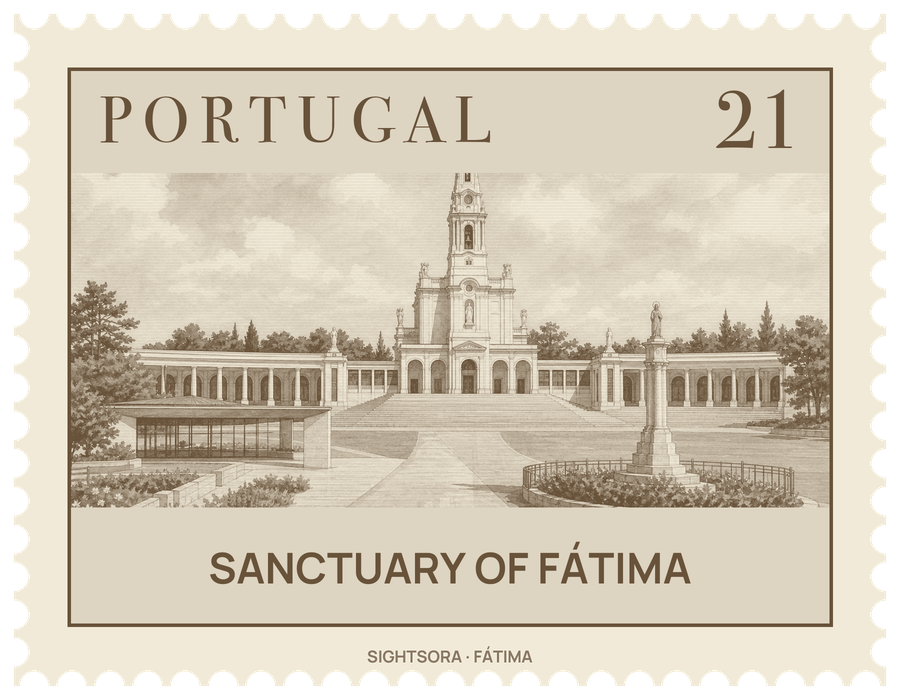
Designed by the Rotterdam-born architect Gerardus Samuel van Krieken, the Rosary basilica dedicated to Our Lady stands over the esplanade with a central bell tower about 65 metres high, topped by a bronze crown and an illuminated cross. Its first stone was laid in 1928, and the church was consecrated in 1953 and raised to a basilica by Pope Pius XII the following year; the colonnade by António Lino was built between 1949 and 1954. In a niche of the tower stands a statue of the Immaculate Heart of Mary, and above the main entrance a statue of Our Lady of Fátima carved by the American priest Thomas McGlynn after long conversations with Sister Lúcia, a gift from American Catholics in 1958. The tombs of Francisco and Jacinta Marto, who died young in the 1918 flu pandemic, were brought into the basilica in 1951 and 1952.
Inside, stained glass windows tell the story of the apparitions, and each of the fifteen altars belongs to one of the Rosary's fifteen mysteries. A carillon of 62 bells hangs in the tower, and the high choir holds a five-section organ with about 12,000 pipes. At the four corners stand statues of four saints devoted to the Rosary and the Immaculate Heart of Mary: Dominic, John Eudes, Anthony Mary Claret and Stephen of Hungary.
Opposite rises a far bigger church, the Basilica of the Most Holy Trinity, built because the older church was too small for the great pilgrimages. At the end of the left colonnade, the Chapel of the Sacred Lausperene, consecrated in 1987, has stained glass at its entrance depicting the Last Supper and the manna sent down in the desert. The treasury keeps the Irish Monstrance, given in 1949. Near the entrance, south of the rectory, stands a segment of the Berlin Wall, placed there to express the belief that Rosary prayers linked to the Fátima message played a part in its fall. The Paul VI Pastoral Centre, opened by Pope John Paul II in 1982, is a centre where the Fátima message is studied and reflected on.