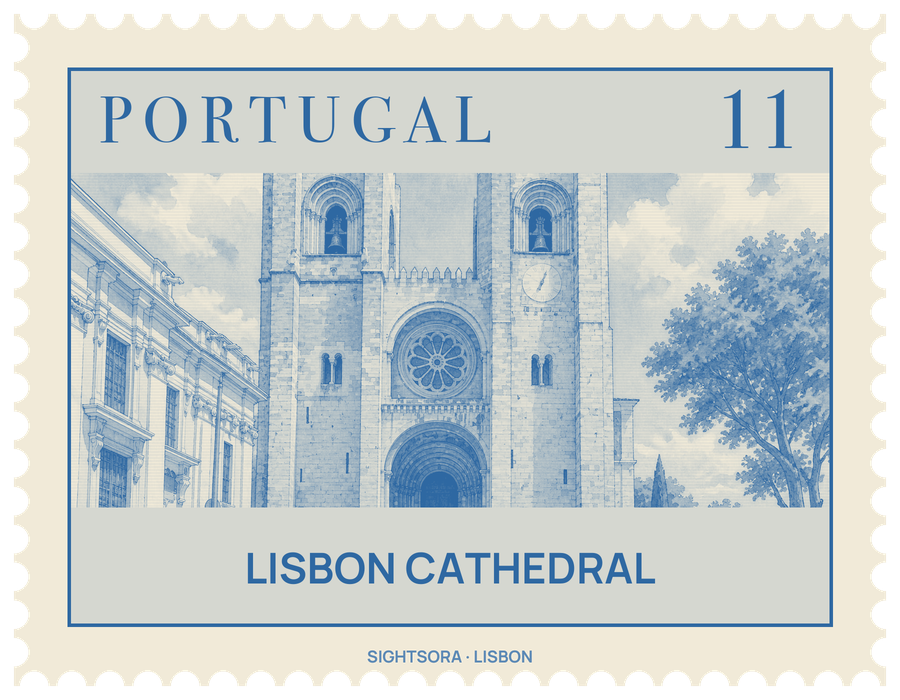
Dedicated to Saint Mary Major and serving as the Patriarchate of Lisbon's seat, it has been a National Monument since 1910. Begun in 1147, it has been damaged by earthquakes and rebuilt several times, so Romanesque, Gothic, Baroque and later work sit side by side.
The cathedral was founded right after the reconquest of 1147, when King Afonso Henriques and northern European crusaders of the Second Crusade took Lisbon; an English crusader, Gilbert of Hastings, became bishop, and the new church went up on the site of the city's main mosque. The relics of St Vincent of Saragossa, Lisbon's patron saint, were brought here soon after. During the crisis of 1383–85 an angry crowd threw Bishop Martinho Annes from the north tower, suspecting him of plotting with the Castilians. The 1755 earthquake and the fire after it wrecked the Gothic main chapel and royal pantheon and much of the cloister, and an early 20th-century renovation stripped away later decoration to bring back a more medieval look.
The west front, with its main portal and rose window (pieced back together from fragments in the 20th century), and the barrel-vaulted nave with its arched upper gallery survive from the first Romanesque building, and the carved capitals of the portals are worth a close look. The church follows a Latin-cross plan with three aisles, a transept lit by a lantern tower and a main chapel; the present main chapel was rebuilt after 1755 in neoclassical and Rococo styles. Near the entrance, the Gothic chapel of the merchant Bartolomeu Joanes holds his tomb and a crib by the sculptor Machado de Castro, and the Baroque sacristy dates from the 17th century.
Behind the main chapel, the Gothic ambulatory built under King Afonso IV survived the earthquake: a ring of radiating chapels beneath a ribbed vault, lit by a row of upper windows, with a Romanesque iron gate in one of the chapels. It holds three carved tombs from the mid-14th century: the nobleman Lopo Fernandes Pacheco, gripping his sword with a dog at his feet; his wife Maria de Vilalobos, reading a Book of Hours; and an unidentified royal princess. The Gothic cloister founded by King Dinis lies to the east. Excavations in its courtyard, begun in 1990, uncovered a Roman road lined with shops, part of a Roman kitchen and a sewer, traces of Visigothic buildings, and red walls from the mosque that once stood here.