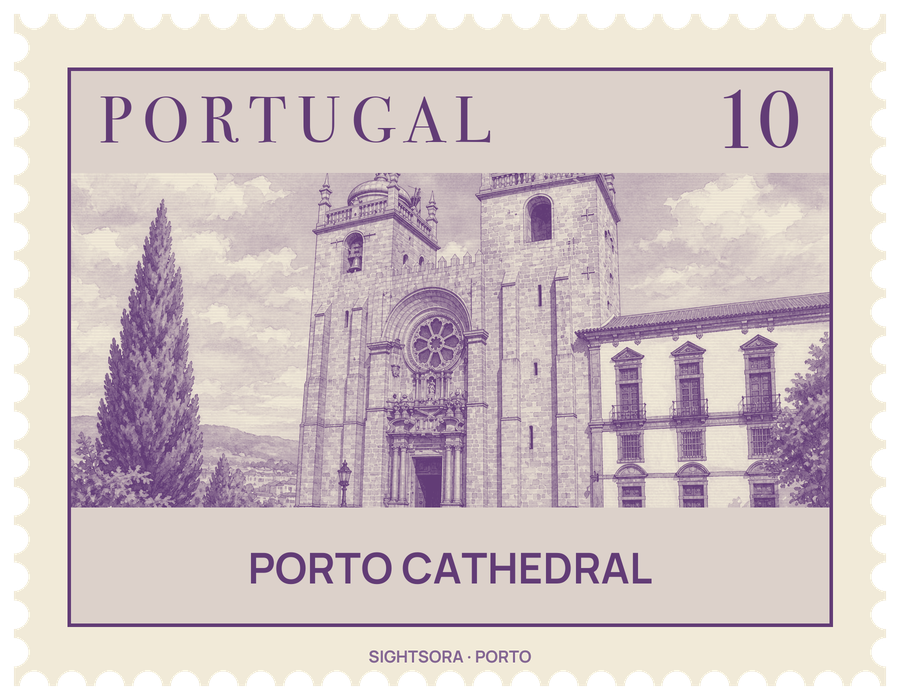
Work on it started on the site of an older chapel in the later part of the 12th century and went on into the 16th century, and was reworked in Baroque times. In 1387 King John I married the English princess Philippa of Lancaster here.
From outside, the plain, mixed façade carries a Romanesque rose window under a crenellated arch, a Baroque porch, and a main portal that replaced the medieval one in 1772. On the side facing the city, the Italian architect Nicolau Nasoni added an open Baroque loggia in 1736. Inside, the narrow nave rises between thick clustered pillars under a barrel vault, with lower aisles on either side, and the whole building was heavily restored in the 20th century.
The chancel was rebuilt in the 17th century in place of the medieval apse; its gilded wood altarpiece, carved between 1727 and 1729, is a major piece of Portuguese Baroque, and Nasoni painted the walls around it. Two pipe organs stand above the canons' stalls. In the chapel of the SS. Sacramento is a large silver altar, worked in successive phases and covered with biblical scenes. The left arm of the transept holds the 14th-century image of Nossa Senhora da Vandoma, patron of Porto, and near the old font is a bronze relief of the baptism of Christ by António Teixeira Lopes.
The Gothic cloister, reached from the south transept and begun at the end of the 14th century, is lined with large azulejo panels by Valentim de Almeida showing scenes from the Song of Songs. Off it lies the funerary chapel of João Gordo, a Knight Hospitaller in the service of King Dinis I, whose tomb has his recumbent figure. The Chapel of S. Vicente keeps 17th-century carved stalls with biblical scenes and the tombs of several bishops of Porto. A grand staircase by Nasoni, finished in 1736, climbs to the cloister's upper terrace, which looks out over the city and is decorated with tile panels of country and mythological scenes.
Next to the cloister is the Casa do Cabido, the early 18th-century chapter house. Its upper floor displays religious sculpture from the 14th to the 18th centuries, and the chapter hall has a ceiling painted by Pachini in 1737 with fourteen moral allegories around S. Miguel, patron of the chapter, above wall tiles with hunting scenes. The cathedral treasure, with silverwork, vestments and liturgical books, is shown in four small vaulted rooms on the middle floor.