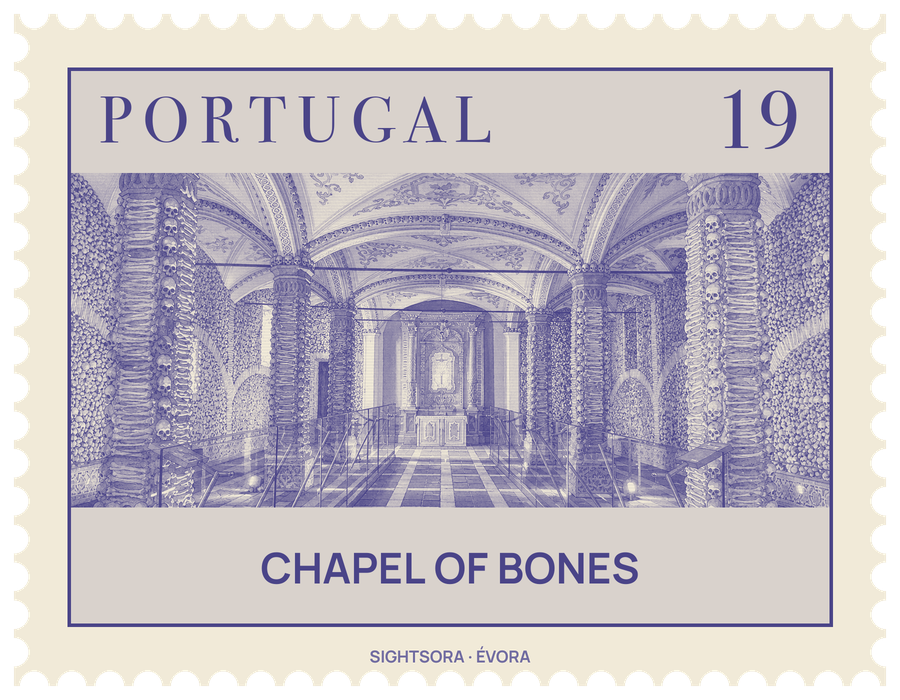
Franciscan friars built it, digging up the remains of an estimated 5,000 people from the medieval cemeteries of Évora, many of which lay inside several dozen of the town's churches. The dead were ordinary townspeople, and the friars laid their bones out in deliberate patterns.
Above the entrance, an inscription greets visitors with the words "We bones that are here await yours." Inside, the chapel is made up of three spans, 18.7 m long and 11 m wide, lit only by three small openings on the left-hand side. Skulls and long bones, fixed with cement, cover the walls and all eight pillars, while the white-painted brick vault above is decorated with images of death. Two dried bodies, one of them a child's, lie in glass cases, and a verse from Ecclesiastes in the Vulgate, "Melior est dies mortis die nativitatis", runs across the ceiling, declaring the day of death better than the day of one's birth.
The purpose of the place is meditation on mortality rather than horror. On one of the pillars, an old wooden frame holds a poem credited to Fr. António da Ascenção Teles, who served from 1845 to 1848 as priest of São Pedro, the parish of the Church of St. Francis. It addresses a hurrying traveller, urges them to stop and consider how many have already passed from this life, and ends with the paradox that the longer one pauses here, the further one advances. Some of the skulls carry graffiti scratched by later visitors.