His holdings begin in Ancient Egypt, reach into the early 20th century and take in Islamic art, art from Japan and China, alongside European painting and French decorative arts. The museum keeps about 6000 items, and roughly 1000 of them are on permanent view. Gulbenkian's motto, "only the best", explains the level of the pieces; some of the paintings came to him when the Soviet government sold works from the Hermitage.
The galleries are arranged by period and by region into two separate circuits, so visitors can follow either one on its own. The first covers the ancient world and the East: Greco-Roman art from classical antiquity, objects from the Nile Valley and the ancient Near East, Egyptian, Mesopotamian, Persian and Armenian pieces, and Persian art of the Islamic period.
The second circuit is European. It opens with ivories and illuminated manuscripts, moves through sculpture and painting of the 15th to 17th centuries and a room of Renaissance art from the Netherlands, Flanders, France and Italy, and gives generous space to 18th-century French furniture, gold and silver. Painters on the walls include Rembrandt, Rubens, Van Dyck, Frans Hals, Ghirlandaio, Carpaccio, Gainsborough, Turner, Corot, Manet, Degas, Renoir and Monet, and there is a large group of works by the Venetian Francesco Guardi. The tour ends in a room of its own given to the jewellery and glass of René Lalique; one example is the «Orquídeas» diadem, with two orchids carved in horn and a third in ivory, and a small drop-shaped citrine at the centre.
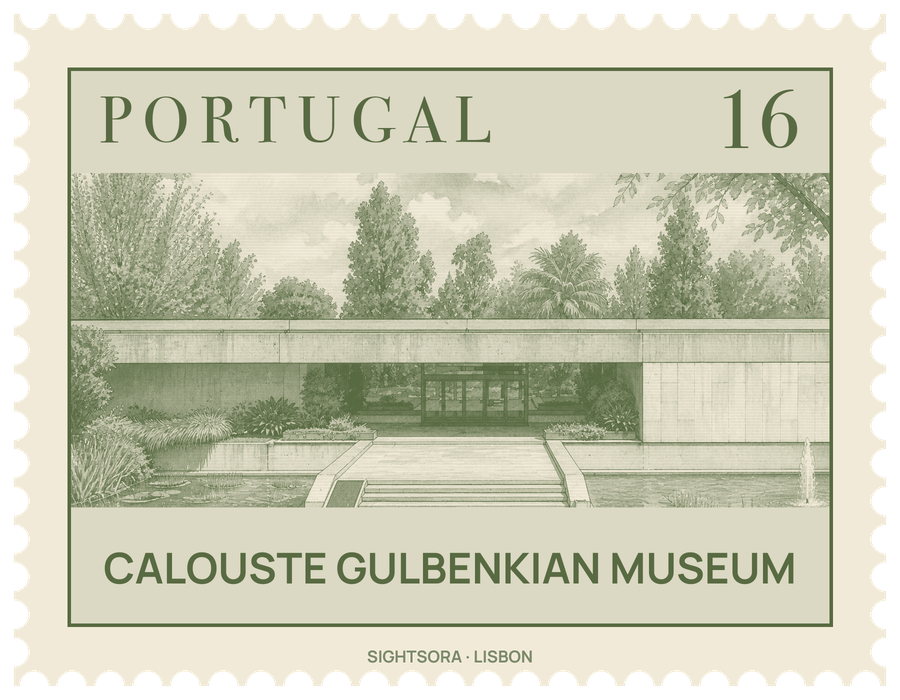
Unlike many art museums of its era, the building was designed from the start to hold this collection. A team of architects led by Ruy Jervis d'Athouguia, Pedro Cid and Alberto J. Pessoa won the competition for the foundation's headquarters, while António Viana Barreto and Gonçalo Ribeiro Telles shaped the park around it; the buildings and gardens were inaugurated on 2 October 1969 and received the Valmor Prize in 1975. Inside, windows open onto woodland and water, and paths through the park lead past terraces and pools at the edge of the building. In the main entrance hall hangs Almada Negreiros's panel Começar.
At the southern end of the park stands the Centro de Arte Moderna (CAM), the country's first museum of modern art when it opened in 1983. Its original building by the British architect Leslie Martin was redeveloped by Kengo Kuma and Associates and reopened in 2024, with a 100m-long entrance canopy of dark ash planks and white handmade tiles modelled on the Japanese engawa veranda.