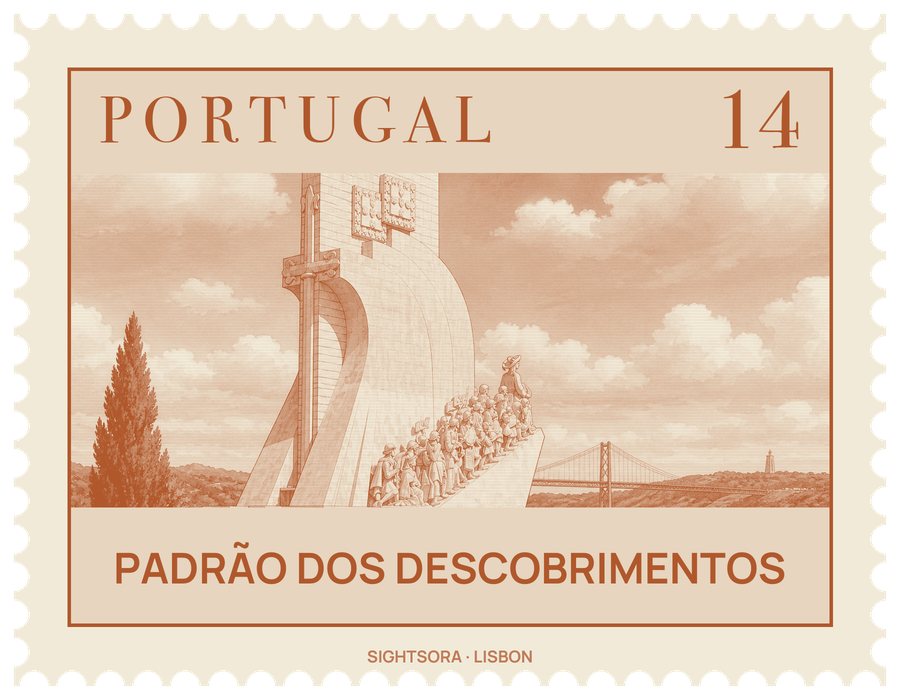
Henry the Navigator stands at the tip of the prow holding a model ship, and behind him on both sloping sides rows of monarchs, explorers, cartographers, artists, scientists and missionaries lean forward towards the open water.
The first version was a temporary structure of steel and cement with plaster figures, designed by the architect José Ângelo Cottinelli Telmo and the sculptor Leopoldo de Almeida for the Portuguese World Exhibition of 1940, and it was pulled down by 1943. The permanent monument was built between 1958 and 1960 in cement clad in rose-tinted stone from Leiria, with statues carved from Sintra limestone, on a larger scale than the original, to mark five centuries since the death of Henry the Navigator; it was inaugurated on 9 August 1960. Its idealised picture of the voyages reflects the outlook of António de Oliveira Salazar's Estado Novo.
In front of the monument, a giant compass rose 50 metres across is set into the paving in different kinds of limestone, a gift of the South African government designed by Cristino da Silva. At its centre lies a world map 14 metres wide tracing the routes of Portuguese carracks and caravels. On the landward side, metal inscriptions on either side of the stairs dedicate the monument to Prince Henry and to the Portuguese who discovered the paths of the sea, and to his fifth centenary, 1460–1960.
Since 1985 the interior has been open as a cultural centre, with an auditorium and rooms for exhibitions on several levels. A lift or a climb of 267 stairs leads to the top, which looks over the Tagus and the Belém district, taking in the Jerónimos Monastery and the Belém Tower, the monastery standing across the Avenida de Brasília.