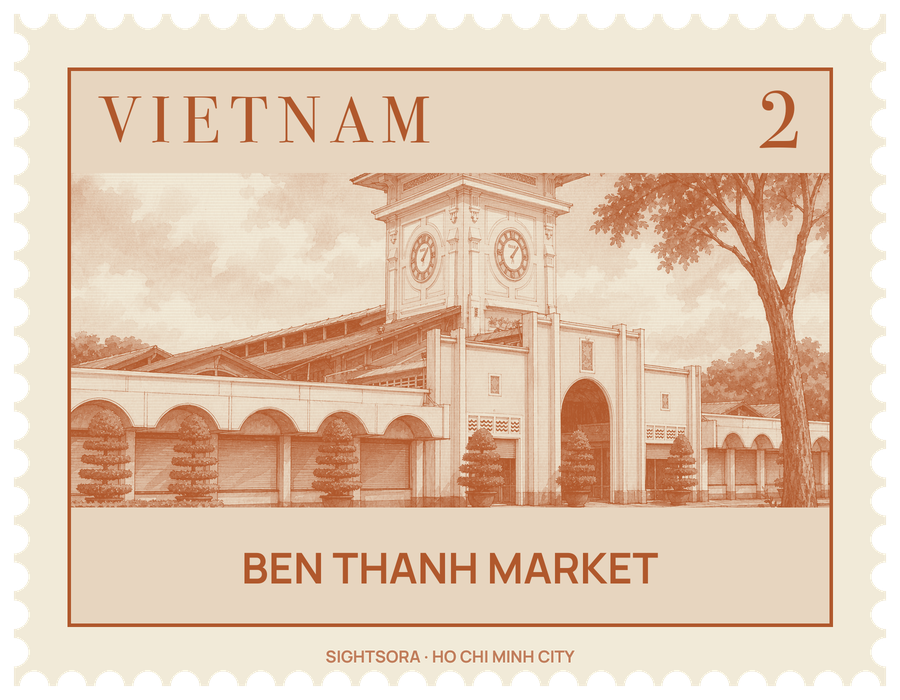
The building opened in 1912, a fireproof metal hall in a French Indochinese style built by the French firm Etablissements Brossard & Mopin, and it is one of the earliest structures still standing in the city. Its name joins the Vietnamese words for "harbour" and "citadel".
Trading here goes back much further. Street vendors began gathering near the Saigon River in the early 17th century, close to the old Gia Định citadel, and boats used the surrounding canals to bring goods in. After the French took the citadel in 1859 they made the market a formal one; its thatched building burned in 1870 and was rebuilt. When the stallholders moved to the new hall near the Mỹ Tho railway station in 1912, the old building stayed in use as a wholesale market, the Chợ Cũ or Old Market. The 1912 hall had a major renovation in 1985, and according to the head of the city's Architects' Association its orientation and the long roof banners that shade the interior were designed to keep it naturally cool.
Each of the four gates leads to its own trade, which makes the gates a handy way to find things. Around the south gate are clothes, fabric, shoes, jewellery and cosmetics. The north side has fresh fruit, fish and poultry, plus the cooked-food stalls: pho, bun bo hue, bun thit nuong, broken rice, banh beo, desserts and grilled seafood. The east side sells packaged food to take home, such as coffee beans, tea, dried seafood, fish sauce, spices, herbs, candied fruit and roasted peanuts, while the west side is given over mainly to crafts and ceramics.
In the evening the trade spills outside: vendors set up lit stalls along both sides of Phan Bội Châu and Phan Chu Trinh streets, selling much the same goods as by day but with more food. Some stalls grow into small open-air restaurants with tables, and many offer menus in English.
Getting there
The market is a major hub for city buses and stands next to Ben Thanh station on Line 1 of the Ho Chi Minh City Metro, opened on 22 December 2024, which links it with Vietnam National University, Suối Tiên Park and the Eastern Bus Terminus. Tan Son Nhat International Airport lies about 7 kilometres to the northwest; taxis, Grab, motorbikes and buses all make the trip.