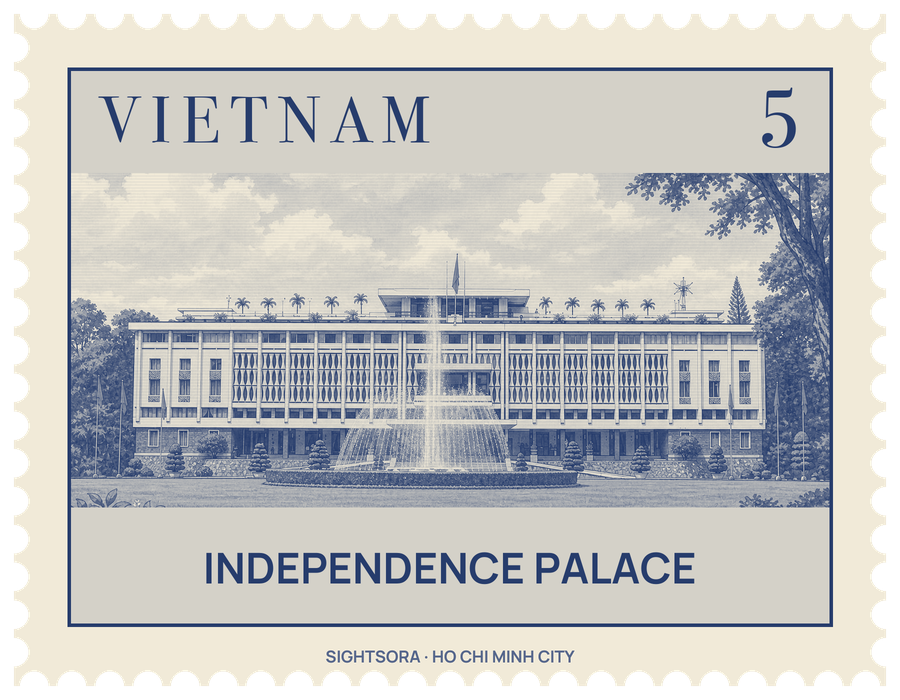
Until then the building had been where the South Vietnamese president lived and worked. Today it is kept both as a hall for state events, under the name Reunification Hall (Hội trường Thống Nhất), and as a museum open to the public under its older name, Dinh Độc Lập.
President Ngô Đình Diệm ordered the present palace in 1962 to replace an older one that two dissident air force pilots had badly damaged in a bombing raid. Its architect, Ngô Viết Thụ, had won the Grand Prix de Rome in 1955. Work began on 1 July 1962, but Diệm never saw the result: he and his brother Ngô Đình Nhu were killed after a coup in November 1963. General Nguyễn Văn Thiệu opened the hall on 31 October 1966 and lived and worked there from 1967 until he fled the country on 21 April 1975. Earlier that month, on 8 April, a South Vietnamese pilot who was secretly a communist agent bombed the palace from an F-5E, without causing serious damage.
Rooms on view include the president's office and the banquet chamber, and beneath the palace lies the old war room. A Vietnamese T-54 tank stands in the gardens by the entrance. The palace was also printed on South Vietnam's 200-đồng banknote.