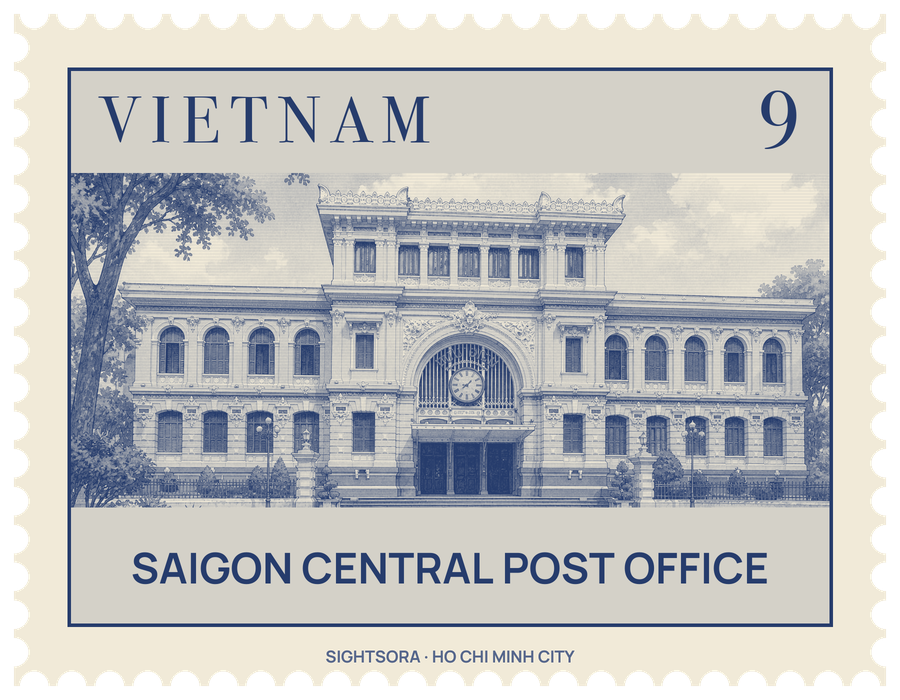
It was built between 1886 and 1891, when Vietnam was part of French Indochina, and mixes Gothic, Renaissance and French influences. Its architect was Alfred Foulhoux, chief architect of the colony, although the building is often wrongly credited to Gustave Eiffel; it was inaugurated on 14 July 1891.
On the outer walls, plaques honour scientists and engineers whose work underlay the communication technology of the day, among them Morse, Ampère, Volta, Ohm and Faraday. Inside, two painted maps made shortly after the building opened are the details to look for: one, on the left side of the hall, shows the telegraph lines of southern Vietnam and Cambodia in 1892, the other Saigon and its surroundings in the same year. A portrait of Ho Chi Minh hangs in the centre of the back wall. From 1990 to 2021 the hall was the workplace of Dương Văn Ngộ, known as the last public letter writer in Vietnam.