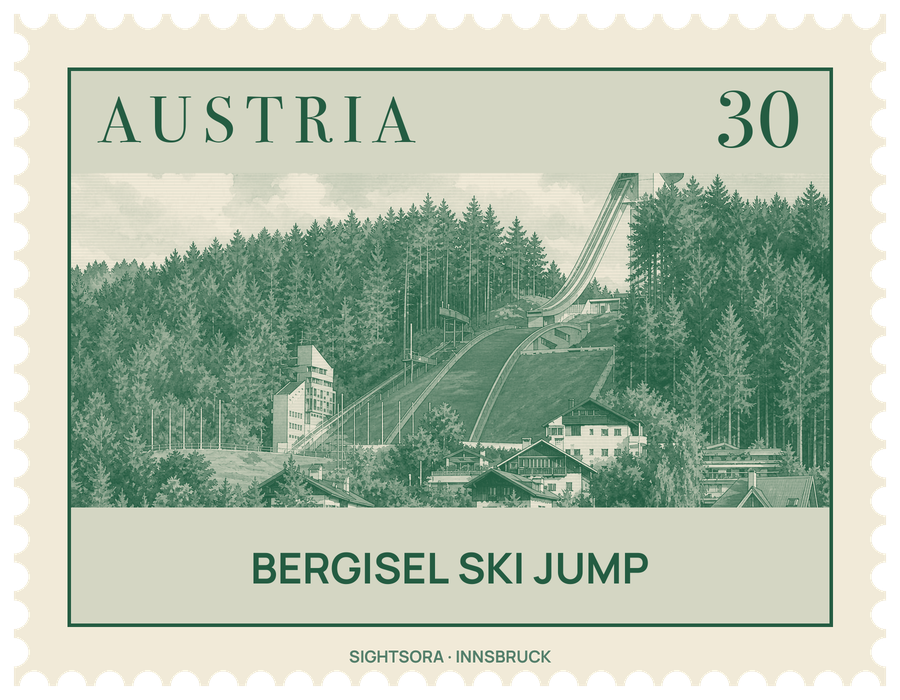
Her practice won the international competition for it in December 1999, and the new structure replaced an older jump that no longer met international standards, as part of a wider refurbishment of the Olympic Arena.
Ski jumping on this hill goes back a long way. Simple wooden jumps were used for the first competitions in the 1920s, a larger hill was built in 1930, and it was rebuilt for the 1964 Winter Olympics; the Olympic flame burned on the Bergisel during the Games of 1964 and again in 1976. The hill also carries older memories for Tyrol: Tyroleans led by Andreas Hofer fought here for their country's freedom, and in 1988 Pope John Paul II celebrated a Mass at the stadium for 60,000 people.
Hadid's building fuses three things into one shape: the jump tower, a café and the in-run. At about 90 metres long and almost 50 metres high, it works as both a tower and a bridge, with a vertical concrete core and a steel space frame carrying the ramp and the café. The jump has an artificial surface, with the in-run made of a special porcelain and fibre damping mats laid over the landing slope, so athletes can train on it all year, and it is a FIS competition venue that hosts a round of the Four Hills Tournament every season.
For visitors who are not jumpers, the draw is the view. A funicular and a tower lift lead up to the panoramic café, "Café im Turm", and to a viewing terrace on top of the jump tower, with views down to the stadium and Innsbruck and across to the Nordkette range. A ski jump with a public café and terrace at its head is unusual, and the Innsbruck tourist board counts the building as a modern symbol of the city.
Close by on the same hill is the Tirol Panorama Museum, opened in 2011, whose Giant Panoramic Painting covers a 1,000 m² canvas with the Third Battle of Bergisel, fought on 13 August 1809. A walk from the museum to the jump passes the former shooting huts of the Tyrolean Imperial Infantry and the statue of Andreas Hofer.
Getting there
The jump stands on the Bergisel hill overlooking downtown Innsbruck. From the official car park, steps with cobblestones lead to the stadium ticket office; a funicular and a tower lift then climb to the café and viewing platform.