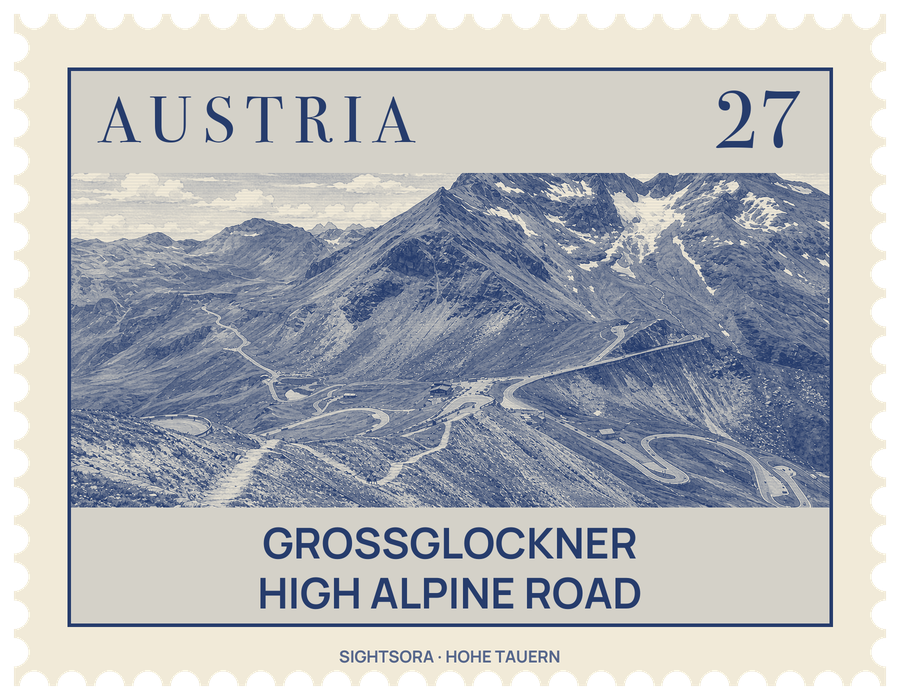
Its 36 hairpin bends carry drivers, motorcyclists and cyclists up to the Hochtor at 2,504 metres, and it is named after the Grossglockner, the mountain it approaches at the Kaiser-Franz-Josefs-Höhe. The road has been a protected monument since 2015.
It was built as a job-creation scheme after the 1929 stock market crash had hit an impoverished Austria hard. The first blasting took place at Ferleiten on 30 August 1930, the provincial governor Franz Rehrl and the engineer Franz Wallack drove across in a Steyr 100 car four years later, and the road opened on 3 August 1935, celebrated the next day with an international car and motorcycle race. From 1953 onwards it was widened in stages to 7.5 metres and given wider bends and far more parking.
Heading south from the toll station at Ferleiten, the road rises to the Fuscher Törl at 2,428 metres, where a side road of 1.5 kilometres branches off to the Edelweiß-Spitze, at 2,571 metres the highest point that cars can reach; from there more than 30 summits above three thousand metres are in view. The main road passes through a tunnel beneath the Hochtor and then descends towards Heiligenblut. On the way, between valley floor and summit, it passes through four zones of vegetation, from mountain forest through treeless alpine meadow to the realm of glaciers and bare peaks.
A second side road leads to the Kaiser-Franz-Josefs-Höhe at 2,369 metres, named after the visit of Emperor Franz Joseph I and his consort Elisabeth in 1856. From this viewpoint and visitor centre the panorama takes in the Johannisberg to the northwest, the Glocknerwand, the Grossglockner massif and the Pasterze Glacier below, and the Glocknerhaus mountain hut lies on the same branch.
The road is also a starting point for walks: themed and panoramic trails and a wide network of hiking paths begin right beside it, with inns and huts along the way, and exhibitions and play areas are spread along the route. The operator, GROHAG, presents five animals as the road's "High Five": the ibex, the golden eagle, the marmot, the Apollofalter butterfly and the alpine bumblebee. A speed limit of 70 is among the measures it uses to protect the landscape.