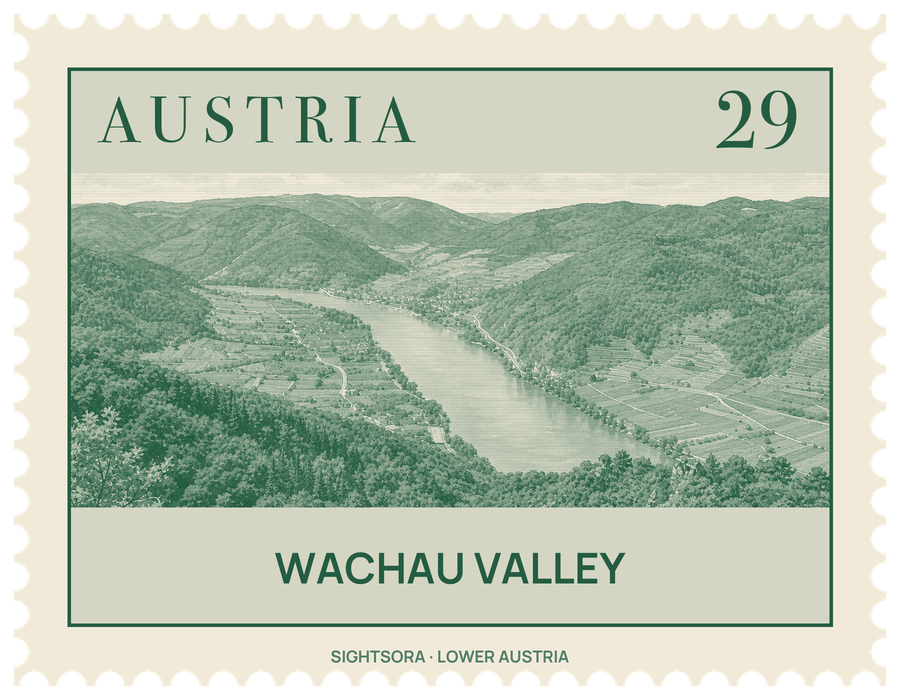
People have lived here since prehistoric times, and the way monasteries, castles, villages and vineyards have grown together over the centuries earned the valley a place on the UNESCO World Heritage List in December 2000 as the Wachau Cultural Landscape. Its monuments number more than 5000, most of them in private hands.
The valley's long story begins early. The Venus of Willendorf, a stone figure only 11 cm long and thought to be about 25,000 years old, came to light at Willendorf in 1908; the original is in the Natural History Museum in Vienna, and a replica is shown in the village. The Romans held the south bank as part of their Danube frontier, with a fort at Favianis, today's Mautern an der Donau, and remains of small watchtowers can still be seen at Bacharnsdorf. The Nibelungenlied, written around 1200, is set partly in this landscape, and fragments of it were found in the library of Melk Abbey.
Dürnstein, a small walled town on a rocky spur about 9 kilometres upstream of Krems, is the best-known stop along the way. In the 12th century Richard the Lionheart, recognised in disguise on his way home from the Holy Land, was held prisoner in the Kuenringerburg, the castle above the town, by Duke Leopold V, and was freed only for a ransom in silver. Further upstream, the Benedictine abbey of Melk marks the western gateway to the valley, while Göttweig Abbey, founded in 1083, stands near Krems at the other end. Between them lie the castle ruin of Aggstein, built in the early 12th century, the town of Spitz with its cobbled lanes, and Weißenkirchen in der Wachau.
Wine shapes both the landscape and the towns. Bavarian and Salzburg monasteries began building vine terraces in the Middle Ages, and Grüner Veltliner and Riesling grapes still grow on the stony slopes above the river, ripened by warm days and cold nights. The growers' association Vinea Wachau, founded in 1983, labels its wines in three categories: Steinfeder, Federspiel and Smaragd. The valley is just as known for its apricots, the Wachauer Marillen, which are made into liqueurs, and the winegrowers' farmhouses, built around courtyards with vaulted passages and Baroque street fronts, are a feature of every village.
The tourist region that includes the Wachau describes a landscape of vineyard terraces, near-natural woods, nature reserves and dry grassland running from Ybbs to Furth bei Göttweig. It can be walked on long-distance trails such as the Welterbesteig Wachau, which links panoramic ridges, wine villages and quiet forest paths, and the valley is also popular for cycling and mountain biking. In autumn the wine villages hold harvest events, and the growers open their own wine taverns, the Heurige, on set dates.
Getting there
Passenger boats on the Danube call at the historic sights of the valley, and a road follows the river between Melk and Krems. The A1 motorway between Vienna and Salzburg passes close to the centre of Melk.