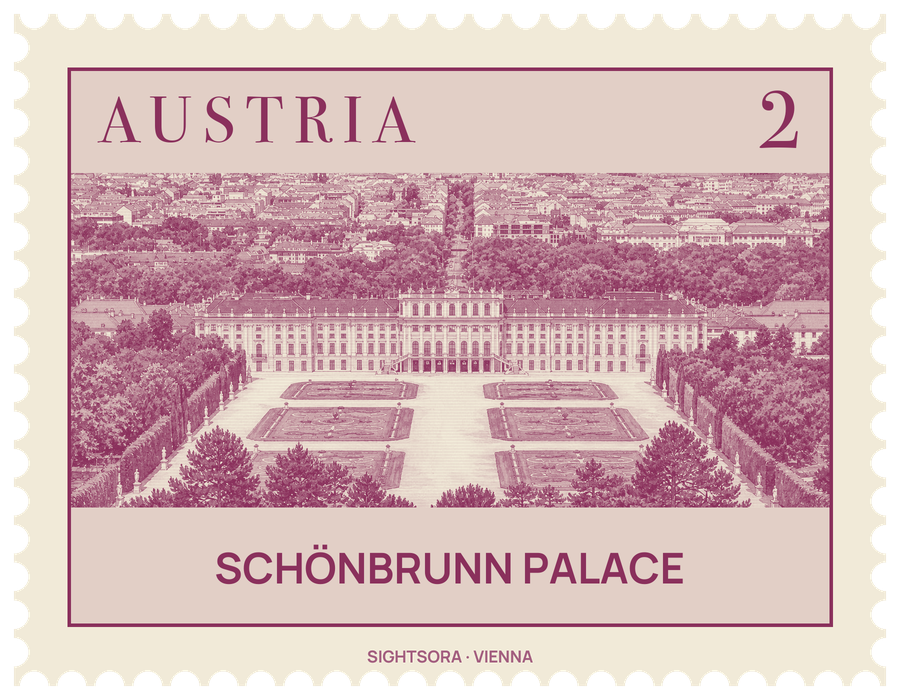
Its name means "beautiful spring", after an artesian well whose water the court drank. UNESCO inscribed the palace and its gardens on the World Heritage List in 1996 as a Baroque ensemble in which architecture, decoration and landscape were planned as one work of art.
The estate began as a hunting ground: Emperor Maximilian II bought the floodplain of the Wien river in 1569 and stocked it with game, and the name Schönbrunn first appears on an invoice in 1642. The palace took its present form in the 1740s and 1750s under Maria Theresa, to whom the estate had been given when she married. Franz Joseph was born here and died here, aged 86, on 21 November 1916; after the monarchy fell in 1918 the building passed to the Austrian Republic and became a museum. In 1961 it hosted the meeting between John F. Kennedy and Nikita Khrushchev.
Visitors tour the main floor with an audio guide, climbing the Blaue Stiege, the palace's ceremonial staircase, which leads only to that floor. The western wing holds the private rooms of Franz Joseph and Elisabeth, including the emperor's study crowded with family pictures, the bedroom where he died, and the couple's bedroom furnished for their wedding in 1854. The Great Gallery, 43 metres long and nearly ten wide, was the setting for court festivities under a gilded stucco and fresco ceiling. Further on, two small cabinets on either side of the Small Gallery are richly fitted with oriental artworks, the gilded Spiegelzimmer shows the rococo style of Maria Theresa's reign, and the three Rosa Rooms take their name from Joseph Rosa, who painted fifteen idealised landscapes for them in the 1760s.
Behind the palace, the Great Parterre runs to the Neptune Fountain, lined by 32 statues of mythological and historical figures made in 1777 for the garden. Beyond the fountain, a 60-metre hill has been crowned by the Gloriette since 1775, built by Maria Theresa's order partly with stone salvaged from Schloss Neugebäude; it closes the view from the garden-side rooms of the palace. Scattered through the park are the Roman Ruin of 1778, a sham ancient arch over a rectangular pool, the Obeliskbrunnen fountain, a maze first laid out around 1720, the orangery and the Palm House of 1881/82. The zoo, the Tiergarten, goes back to the menagerie founded by Franz I. Stephan.
Other parts of the estate have their own displays. The Wagenburg, the carriage museum, has occupied the former winter riding school since 1922 and holds the coaches, state carriages, sleighs and sedan chairs of the Vienna court. A children's museum in the palace shows how the imperial children dressed, played and greeted their parents. The palace marionette theatre stages evening shows, among them Mozart's Die Zauberflöte, and concerts of Mozart and Strauss are played in the Orangery. A diesel-powered train, the Schönbrunner Panoramabahn, links the sights spread across the grounds.