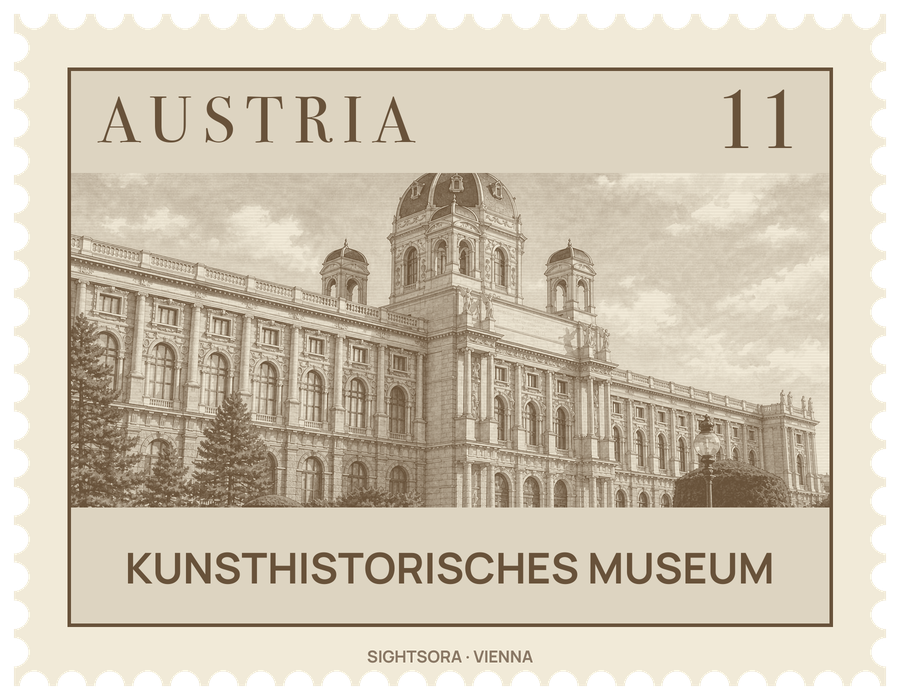
Emperor Franz Joseph had both museums built between 1871 and 1891 to plans by Gottfried Semper and Karl von Hasenauer, so that the art gathered by the Habsburgs would have a fitting home open to the public. The collections span objects from some 5000 years.
The interior is part of the show: marble, stucco, gold leaf and murals, and on the grand staircase paintings by Gustav Klimt, his brother Ernst, Franz Matsch, Hans Makart and Mihály Munkácsy. The core of the holdings comes from Habsburg collectors, among them Ferdinand of Tirol with his portraits and armour, Emperor Rudolph II and Archduke Leopold Wilhelm, a major collector of paintings.
The Picture Gallery is built around old masters of the Renaissance and the 17th century. Pieter Bruegel the Elder is represented by a celebrated group that includes The Hunters in the Snow, The Peasant Wedding, The Fight Between Carnival and Lent and The Procession to Calvary, and there is Giuseppe Arcimboldo's Summer from The Four Seasons. Other highlights include Raphael's Madonna of the Meadow, Dürer's Adoration of the Trinity, Titian, Tintoretto's Susanna and the Elders, Caravaggio's Madonna of the Rosary, Rubens, a Rembrandt self-portrait, Vermeer's The Art of Painting and portraits of the Spanish Habsburgs by Velázquez.
Beyond the paintings, the building houses the Egyptian and Near Eastern Collection, the Collection of Greek and Roman Antiquities and the Collection of Sculpture and Decorative Arts; the renovated and enlarged Kunstkammer rooms reopened in 2013. Among its prized objects is Benvenuto Cellini's salt cellar, stolen in 2003 and recovered in 2006 from a box buried in a forest near Zwettl. The museum also runs collections elsewhere, including the treasury in the Hofburg's Schweizerhof, the carriage museum at Schönbrunn and the collections of Ambras Castle in Innsbruck.