It was the principal palace of the Habsburgs and their winter residence, while Schönbrunn served for the summer. Holy Roman Emperors ruled from here between 1438 and 1583 and once more between 1612 and 1806, Austrian emperors followed until 1918, and since 1946 the president of Austria has lived and worked here.
For most visitors the starting point is the rooms where Emperor Franz Joseph and his wife Elisabeth, better known as Sisi, actually lived, kept as they were. One route links three displays: the Imperial Apartments, the Sisi Museum devoted to the empress, and the Silver Collection, with guided tours through the rooms also offered. The couple's wedding took place nearby in the Augustinian Church, which the Habsburgs used as their court church; behind its Loreto chapel, the Hearts' Crypt keeps 54 hearts of family members in silver urns.
The oldest core is the Swiss Court (Schweizerhof), where the first square castle with four turrets once stood. It is entered through the Renaissance Swiss Gate, which lists the many titles of Ferdinand I and has the Golden Fleece insignia painted on its ceiling. Around it are the Gothic Burgkapelle of the 15th century, where the Vienna Boys' Choir traditionally sings mass, and the Schatzkammer, the treasury where the crown insignia of both the Holy Roman Empire and the Austrian Empire are kept. Across the inner courtyard, the Amalienburg carries a small domed tower and an astronomical clock, and the Leopoldine Wing holds the offices of the Federal President.
On the far side of the complex, the Court Library built for Charles VI was finished by Joseph Emanuel Fischer von Erlach in 1735. Its Prunksaal is the artistic high point of the Hofburg, where Prince Eugene of Savoy's books line the walls beneath Daniel Gran's huge painted ceiling, among imperial statues carved by Paul Strudel; outside, Josephsplatz has a bronze equestrian statue of Joseph II. The Redoutensäle, ballrooms created for Maria Theresa from an early opera house, saw the premiere of Beethoven's 8th Symphony in 1814 and the balls of the Congress of Vienna; after a fire in 1992 they were restored and reopened in 1998.
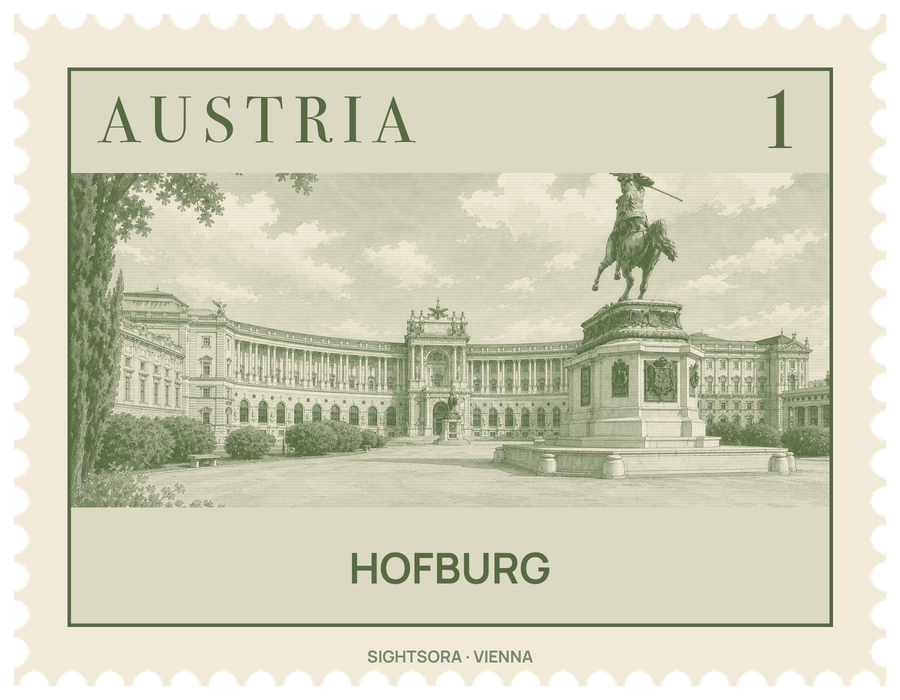
The palace faces Heldenplatz, Heroes' Square, laid out after part of the old bastion was pulled down in 1809, with equestrian statues of Prince Eugene of Savoy and Archduke Charles. The Neue Burg wing behind it, finished in 1913, is the one part of a planned Imperial Forum that was actually built; from its balcony Hitler proclaimed the Anschluss on 15 March 1938. Inside are several museums — the Ephesos Museum, the Museum of Ethnology, and collections of arms and armour and of ancient musical instruments — as well as national library reading rooms. The Burggarten and the Volksgarten, with its Temple of Theseus, were created alongside the square.