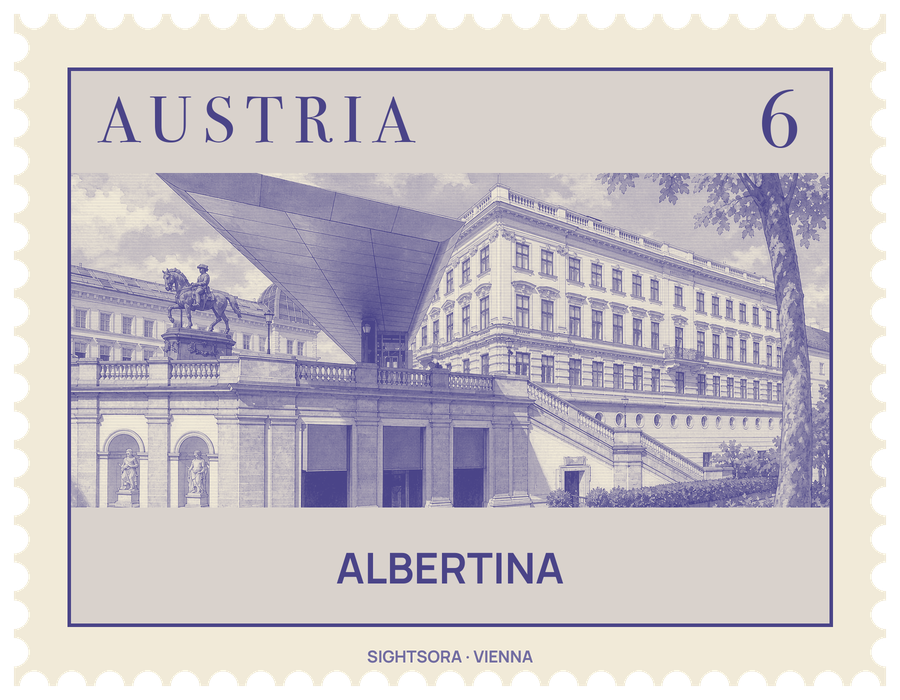
Behind its walls lies a vast collection of works on paper: some 65,000 drawings and about a million old master prints, together with later graphic art, photographs and architectural drawings. Alongside this core, the museum has two permanent loans of paintings, Impressionist works and art from the first decades of the 20th century, part of which is always on view, and it stages temporary exhibitions.
The building began as the court construction office and was turned into a palace in 1744 for Count Silva-Tarouca, the office's director. It then became the residence of Albert Casimir, Duke of Teschen, who brought his graphics collection from Brussels, where he had governed the Habsburg Netherlands, and had the palace enlarged by Louis Montoyer. The collection itself grew out of his contact with Giacomo Durazzo, a Genoese count serving as Austria's envoy to Venice, who in 1776 presented nearly 1,000 works to Albert and Maria Christina, Maria Theresa's daughter. Joseph Kornhäusel reworked the interiors in the 1820s for Archduke Charles.
After the monarchy fell, the state took over both palace and collection in 1919, merged the prints and drawings with those of the former imperial court library in 1920, and gave the building the name Albertina in 1921. Bombs struck it heavily in March 1945; after post-war rebuilding it was fully refurbished between 1998 and 2003, and a new entrance sequence with a distinctive roof by Hans Hollein followed in 2008. The Essl Collection, bought in 2018, added 1,323 contemporary pieces, among them works by Maria Lassnig, Hermann Nitsch, Georg Baselitz, Cindy Sherman and Alex Katz, and since 2020 a separate venue, Albertina modern, has been devoted to modern art.