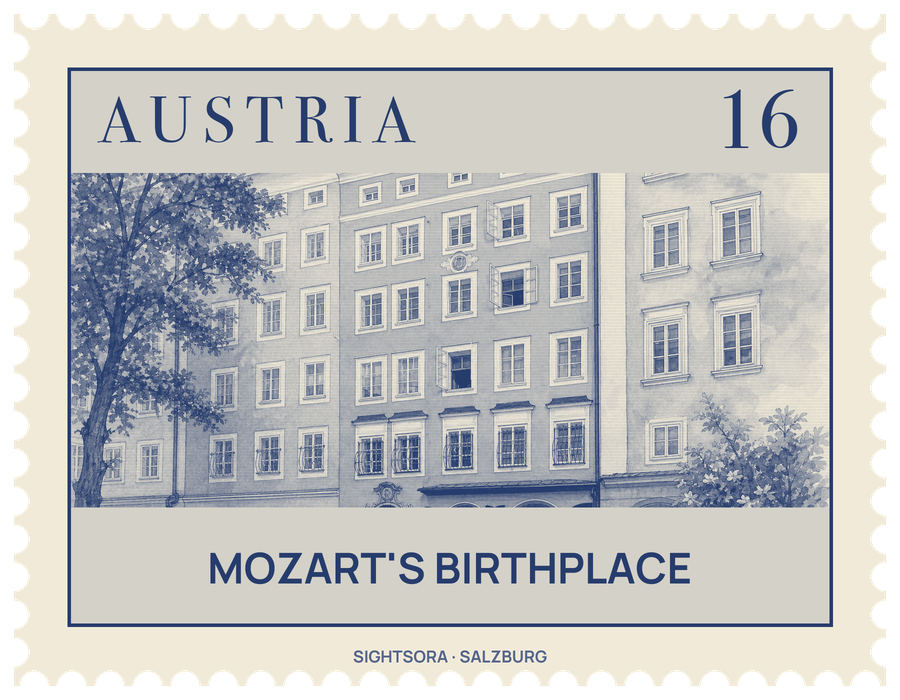
His father Leopold, a musician at the Salzburg court, had rented the rooms after marrying Anna Maria Pertl in 1747, and the family stayed for 26 years. The Internationale Stiftung Mozarteum, the foundation that still owns the building, opened a museum here in 1880, and it now fills the whole house.
The house itself is far older than its famous tenant: it went up in the 12th century on land that had once been a garden of the Benedictine monks of St Peter's. In 1585 the court apothecary Chunrad Fröschmoser bought it, and the snake coiled in a lion's mouth above the doorway, the symbol of Asclepius, still marks his ownership. From 1703 it belonged to the Hagenauer family; Johann Laurenz Hagenauer was Mozart's landlord, and Leopold wrote to him regularly during the family's grand tour between 1763 and 1766.
The family apartment, about 130 square metres, is the core of the museum. Its five rooms comprised an office, a bedroom, a living room, a kitchen and a little cabinet, and seven children were born in it, of whom only Maria Anna and Wolfgang survived. On this floor visitors find Mozart's childhood violin, portraits, family letters, documents and early editions of his music, along with material on his years in Vienna and on his wife and family. One of the portraits is the unfinished one painted in 1789 by his brother-in-law Joseph Lange.
The second floor turns to Mozart's love of opera and displays the clavichord he used while writing The Magic Flute, while the first floor recreates the living conditions of his time with period furniture. A visit takes about an hour. Explanatory texts hang on the walls of the rooms, and text guides can be followed on a mobile phone. The building is not accessible for visitors with reduced mobility.
In 1773 the growing household moved to larger rooms in the Tanzmeisterhaus on what is now the Makartplatz, a house that is also run as a Mozart museum, so the two addresses can be combined on the same day.