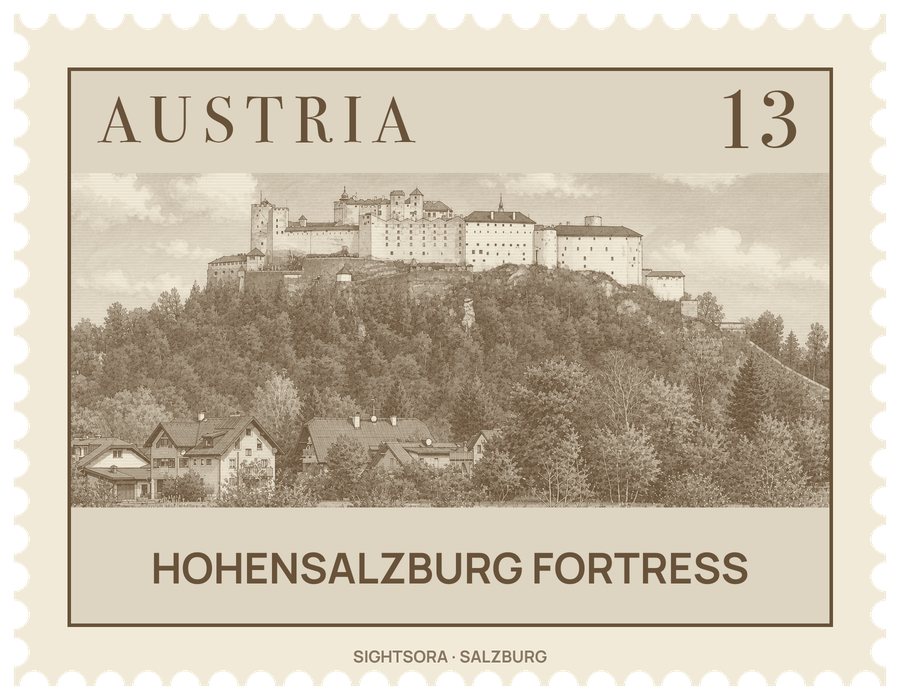
Archbishop Gebhard von Helfenstein began it in 1077 as a simple bailey with a wooden wall, during his conflict with Emperor Henry IV in the Investiture Controversy, and his successors kept enlarging it: the ring walls and towers came in 1462, and the outer bastions, begun in the 16th century and finished in the 17th, were added for fear of a Turkish invasion.
For all its strength, the fortress was besieged only once, in the German Peasants' War of 1525, when miners, farmers and townspeople failed to take it from Archbishop Matthäus Lang. In 1617 its prison saw the death of Wolf Dietrich von Raitenau, an archbishop who had been deposed, and in 1800 it was handed over to French troops without a fight. After serving as barracks, storehouse and dungeon, it was given up as a military post in 1861 and restored from the late 19th century onwards.
Much of what visitors see inside is the work of Archbishop Leonhard von Keutschach, who ruled from 1495 to 1519 and left his emblem, a turnip, all over the building. From 1498 he installed state apartments on the third floor for festivities and display. The Golden Hall has a coffered ceiling studded with gold buttons representing the stars and a 17-metre beam painted with the arms of the archbishop, the Holy Roman Empire, leading German towns and allied bishoprics; four marble pillars carry a loggia on its outer wall. The Golden Chamber is lined with benches carved with vines, grapes, foliage and animals, and the bedchamber keeps its warm wooden wainscoting and a small toilet behind the door, an up-to-date convenience in its day. His chapel has a star vault and stucco around its door.
In the Krautturm, the Salzburger Stier, or Salzburg Bull, is a mechanical organ of more than 200 pipes built in 1502 under Leonhard von Keutschach and renewed by Rochus Egedacher in 1735. Another survivor of his time is the Reisszug, a very early funicular that hauled goods up to the upper courtyard; it was described in 1515 and still exists in updated form.
Getting there
The Festungsbahn funicular, opened in 1892, runs up from the town to the Hasengrabenbastei at the fortress.