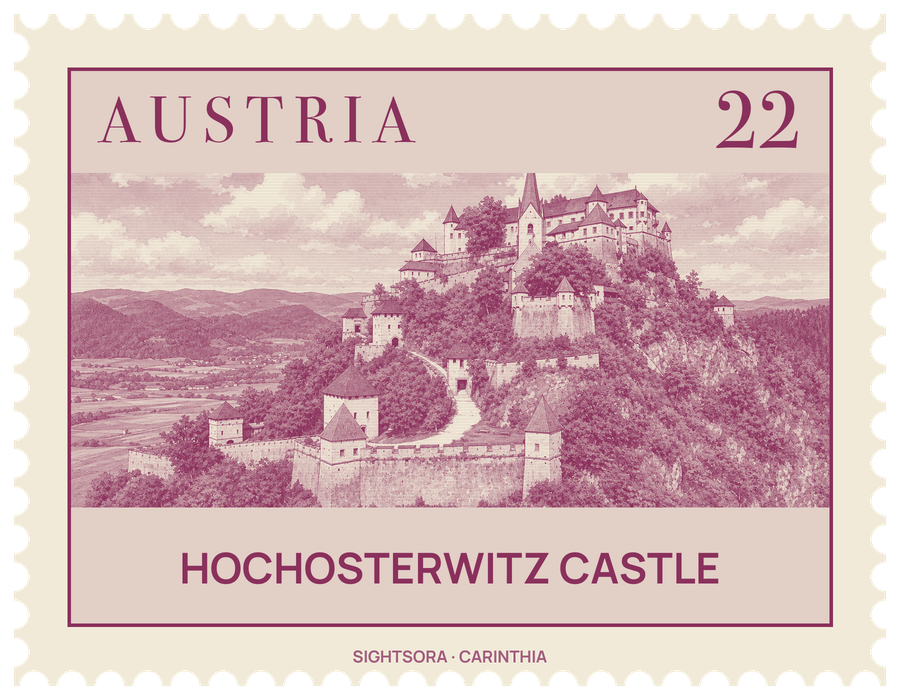
A path guarded by a chain of fortified gates climbs to the top, and on a clear day the castle can be seen from up to 30 kilometres away. The site has been settled since the Bronze Age and first appears in a deed of 860, under the name Astarwiza.
For centuries the rock was held by the Osterwitz family, hereditary cup-bearers at the Carinthian ducal court. When the last of them could not pay his debts to the emperor, the castle passed on 30 May 1478 to the Habsburg emperor Frederick III, and it then suffered heavily from Turkish raids. In 1571 Baron George Khevenhüller bought it and, between 1570 and 1586, built an armory and the 14 gates that defend the path to the top. The castle has stayed in the Khevenhüller family ever since, as he wished, and a marble plaque of 1576 in the courtyard records his request; no major changes have been made since the 16th century.
The way up is the main experience. A path 620 metres long passes through all 14 gates, each one built with a different trap for attackers, and a diagram at every gate explains how it was sealed. Local legend holds that no attack ever got beyond the fourth, the Engelstor. An older tale tells how the garrison, besieged by the troops of Margarethe Maultasch, threw its last ox, stuffed with grain, over the wall to convince the enemy that food was plentiful, and the besiegers gave up. Visitors who prefer not to climb can ride the Fürst-Max-Bahn lift instead.
At the top, the castle museum shows prehistoric finds, Renaissance paintings and the armory's collection of weapons and armour, including a suit 2.4 metres tall once worn by Burghauptmann Schenk. The castle restaurant serves Carinthian food, demonstrations of medieval crafts take place on site, and concerts, exhibitions and festivals are held through the visiting season.
Getting there
The castle can be reached by car, or on foot from Launsdorf-Hochosterwitz railway station, which has connections to Klagenfurt.