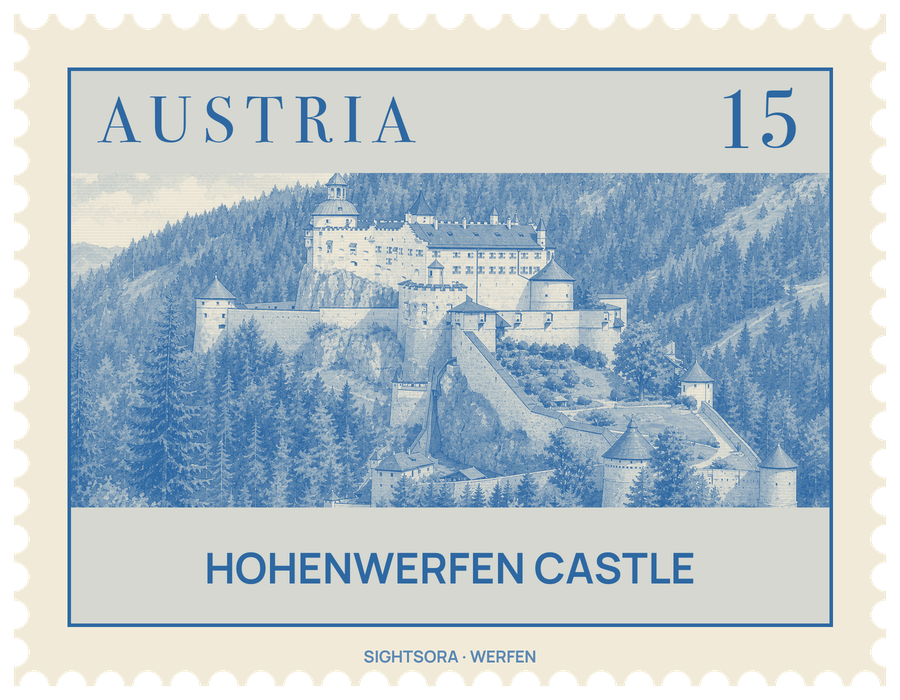
Archbishop Gebhard of Salzburg had it built between 1075 and 1078, during the Investiture Controversy, as one of three strongholds guarding the route along the Salzach against King Henry IV; Hohensalzburg in the city was another, which makes the two fortresses sisters. Gebhard was driven out in 1077, returned in 1086 and died at Hohenwerfen two years later.
For centuries the prince-archbishops used the castle as a military base, a residence and a hunting lodge, and also as a state prison with a grim reputation. Archbishop Adalbert III was held here in 1198, the Styrian governor Siegmund von Dietrichstein in 1525; Prince-Archbishop Wolf Dietrich Raitenau spent six years imprisoned here before dying in 1617. Rebellious farmers and miners set fire to the castle in the Peasants' War of 1525 and 1526, and another fire damaged it in 1931. Under Nazi rule it housed a party training school from 1939, and after the war the Austrian Gendarmerie trained here until 1987. The castle is owned by the state of Salzburg.
Today the castle is run as a museum, and a classic guided tour leads through the walls and the collection of weapons. Two exhibitions are housed in the old armoury: Burgzeiten traces the castle's history and how life and society changed around it, while Der Aufstand tells the story of the Salzburg Peasants' War of 1525/26 with multimedia displays. Further rooms cover the castle's building history and the filming of the 1968 war film Where Eagles Dare, in which Hohenwerfen played the fictional Schloß Adler.
Birds of prey are part of the visit. The Austrian Falconry Museum explains the history and practice of falconry, and in flight demonstrations the falconers fly eagles, falcons, hawks and vultures. Food is served in the Burgschenke, in the castle courtyard in good weather and in the Rittersaal when it rains, and summer cinema evenings and a children's festival are held within the walls.