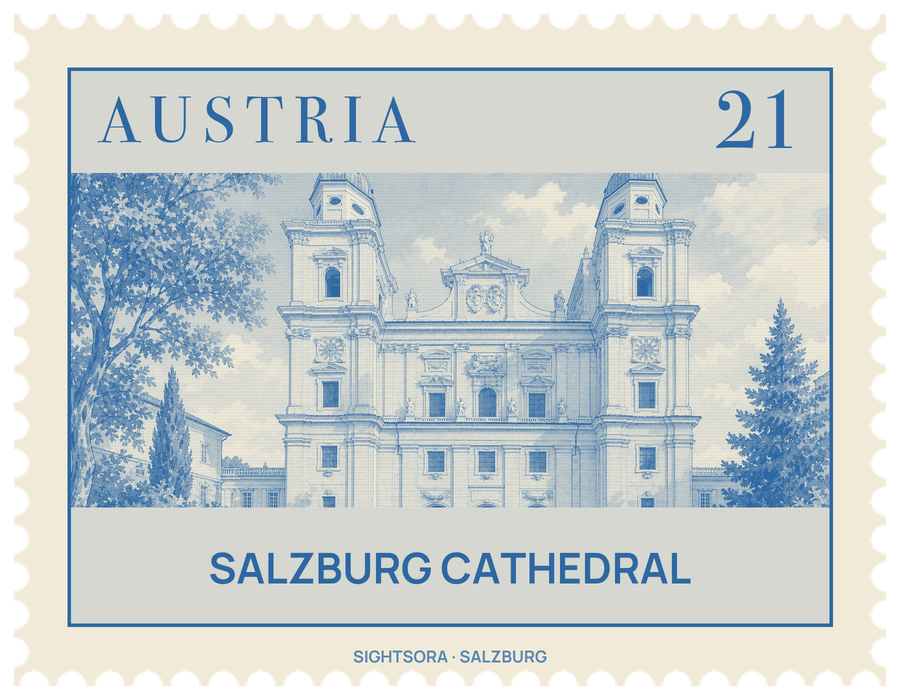
Dedicated to Saint Rupert and Saint Vergilius, it is the seat of the Roman Catholic Archdiocese of Salzburg. Mozart was baptised here on 28 January 1756, a day after his birth, in the 14th-century Gothic font that survives inside, one of the few pieces older than the present building.
A church has stood on this spot since the 8th century: Vergilius built the first cathedral between 767 and 774 on the remains of the Roman town of Juvavum, and it was enlarged several times into a Romanesque basilica. After that basilica was badly damaged in 1598, Prince-Archbishop Wolf Dietrich von Raitenau, an admirer of the new Italian Baroque, had it pulled down and asked Vincenzo Scamozzi for plans. His successor Markus Sittich von Hohenems laid the cornerstone in 1614, and Santino Solari reworked Scamozzi's design into the church that was consecrated on 24 September 1628, when 12 choirs placed in the marble galleries sang a Te Deum by the court Kapellmeister Stefano Bernardi.
The church is 142 metres long and rises 33 metres at the crossing under the dome. In 1944 a single bomb broke through that dome, and the repairs were finished by 1959. Beneath the floor, the Domgrabungen excavation shows foundation stones of the earlier cathedrals together with mosaics and other finds from the forum of Roman Juvavum. The relics of Saint Rupert were brought here when the Baroque church was completed.
The façade, between two towers under a curved gable, rises in three levels. At street level, three tall arches lead to bronze doors from 1957 and 1958 dedicated to faith, love and hope, by Toni Schneider-Manzell, Giacomo Manzù and Ewald Mataré. Statues of Saint Rupert with a salt barrel and Saint Virgilius with a church, carved around 1660 by Bartholomäus van Opstal, stand with Saints Peter and Paul in front of the portals; the four evangelists line the balustrade above, and at the top Christ appears between Moses and Elijah in a Transfiguration group.
Arcades link the cathedral with St. Peter's Abbey and the Residenz, closing the Domplatz into a square 101 metres long and 69 metres wide. In its centre stands the Maria Immaculata column, a marble and cast-iron work that Wolfgang Hagenauer and his brother Johann Baptist made between 1766 and 1771, with the Virgin on a mountain of clouds surrounded by angels, the devil, wisdom and the Church. Seen from the middle of the arcades at the back of the square, the column lines up with the façade so that the Virgin seems to wear the golden crown fixed above the central window. The cathedral's seven bells include two bourdons, Salvator and Rupert, and Rupert strikes the hours.