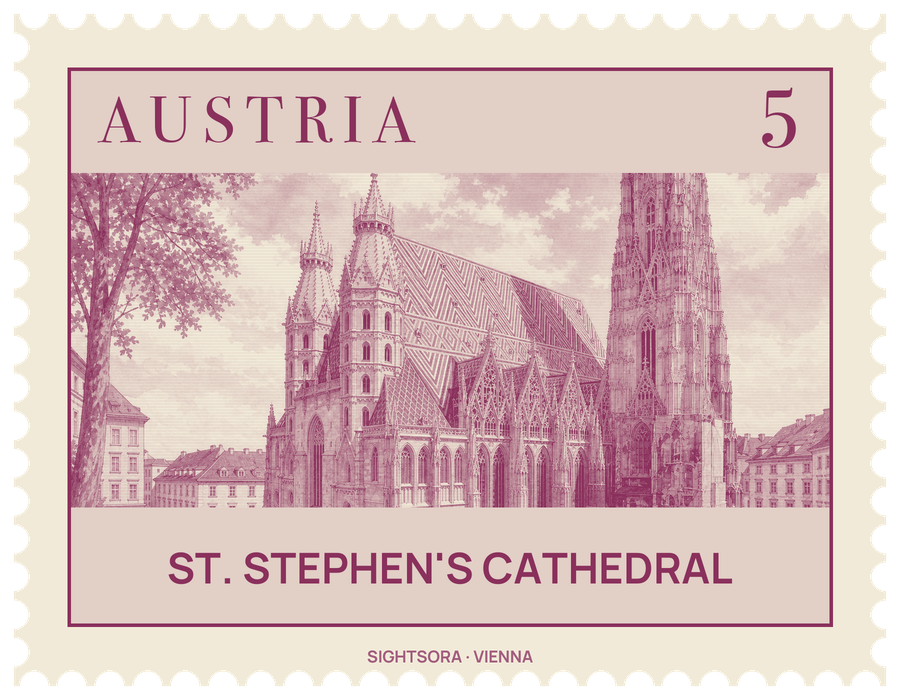
As the archbishop's seat, it heads the archdiocese of the city. A Romanesque parish church was dedicated here in 1147; the Gothic building that visitors see today was largely set in motion by Duke Rudolf IV, who laid the cornerstone of the western extension in 1359.
The south tower, which the Viennese call "Steffl", took 65 years to build and was finished in 1433. During the sieges of 1529 and 1683 defenders of the walled city used it as their chief observation and command point, and watchmen kept a night-time fire watch from an apartment inside it until 1955. Its counterpart on the north side was abandoned in 1511 at 68 metres, roughly half the height, and capped with a Renaissance top in 1578; it holds the great bell known as the Pummerin, recast after the war from the shattered pieces of its predecessor. The oldest parts of the church are on the west front: the Giant's Door, or Riesentor, with Christ Pantocrator in its tympanum, and the two Heidentürme beside it, built from the rubble of Roman structures.
The roof, 111 metres long and steep enough that rain keeps it clean, is covered with 230,000 glazed tiles. Above the choir to the south the tiles make up the double-headed eagle of the Habsburg empire, while the northern slope carries the city's and the republic's coats of arms. In April 1945, fire spread from looted shops nearby, the old wooden roof frame burned and collapsed, and it was replaced with more than 600 tonnes of steel; the church reopened in full on 23 April 1952. Outside the main entrance, two iron bars set into the wall are the old Viennese ell standards against which merchants measured cloth.
Inside, the eye is drawn down the nave to the Baroque High Altar, made by Tobias Pock between 1641 and 1647 from marble brought from Poland, Styria and Tyrol and showing the stoning of St. Stephen. At the head of the north nave stands the Wiener Neustädter Altar, ordered by Emperor Frederick III in 1447, with his famous motto device painted on the predella. The late Gothic stone pulpit stands against a pillar in the nave so that preachers could be heard; its handrail is carved with toads and lizards fighting, and beneath the stairs a sculptor leans out of a stone window, the figure known as the Fenstergucker. Frederick III lies in a red marble tomb carved by Niclaes Gerhaert van Leyden with 240 statues, and the Maria Pötsch icon, brought from Hungary in 1697, hangs under a medieval stone canopy near the south-west corner of the nave.
The cathedral offers a range of guided tours, and visitors can climb the towers for a view over Vienna. Below the church, the catacombs hold the remains of more than 11,000 people, moved here from the surrounding cemeteries when they closed in 1735, and they can be visited on a tour. The Ducal Crypt under the chancel, built at the order of Rudolf IV, contains the bodies, hearts or viscera of 72 Habsburgs. Mozart, whose parish church this was, married here in 1782, and his funeral took place in the Chapel of the Cross in 1791; a memorial tablet on the outside wall records his ties to the cathedral.