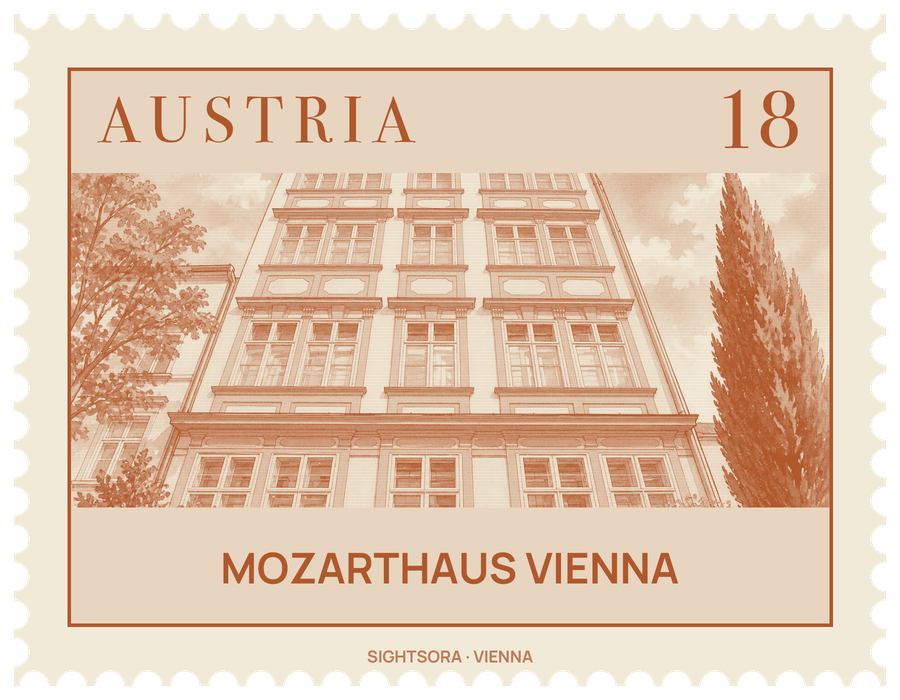
Of all the apartments he rented in the city, this is the only one still standing, and it was also the grandest and costliest of them. Here he wrote The Marriage of Figaro, which is why the building is also called the Figaro House, along with three of the six Haydn Quartets.
The house dates from the 17th century and was rebuilt in 1716; the Camesina family owned it from 1720, and in Mozart's day it carried their name as the Camesina House. The door he used, on the Schulerstraße side, was later bricked up to make way for a shop, so visitors now come in from the back, on Domgasse. The rooms were first shown to the public in 1941 during a Mozart week staged by the Nazis to present him as a typically German composer, and from 1945 the Vienna Museum ran the display. For the 250th anniversary of Mozart's birth in 2006, the city's Wien Holding company had the whole building refurbished and turned into a centre on his life and work.
The visit is spread over several floors, around a courtyard lined with the open access galleries known in Vienna as Pawlatschengänge. The third floor looks at Mozart's life in the city: a multimedia installation maps every place he lived in Vienna, and other rooms cover the venues where he performed, the people who mattered to him, his taste for balls, gambling and fashion, and his links with the Freemasons. Small peephole displays and a door looking down on a staged scene of the Graben square hint at the city's less respectable pleasures.
The second floor is about the music. It introduces his fellow composers and musicians in Vienna, his partnership with the librettist Lorenzo da Ponte on The Marriage of Figaro and Don Giovanni, and the Requiem and his final months. In a small theatre installation, scenes from The Magic Flute are assembled as three-dimensional collages. The historic stucco ceilings and wall paintings on this floor give an idea of how the whole house was once decorated.
The apartment itself, on the first floor, has four rooms, two cabinets and a kitchen, and tells the family's story through pictures and documents. Its most unusual object is a flute clock thought to date from around 1790, which plays a version of the Andante in F, K. 616, a piece Mozart probably wrote for a clock of this kind. Below ground, the brick baroque vault of the second basement has been turned into a concert hall, and the house offers guided tours, workshops for groups and chamber concerts.