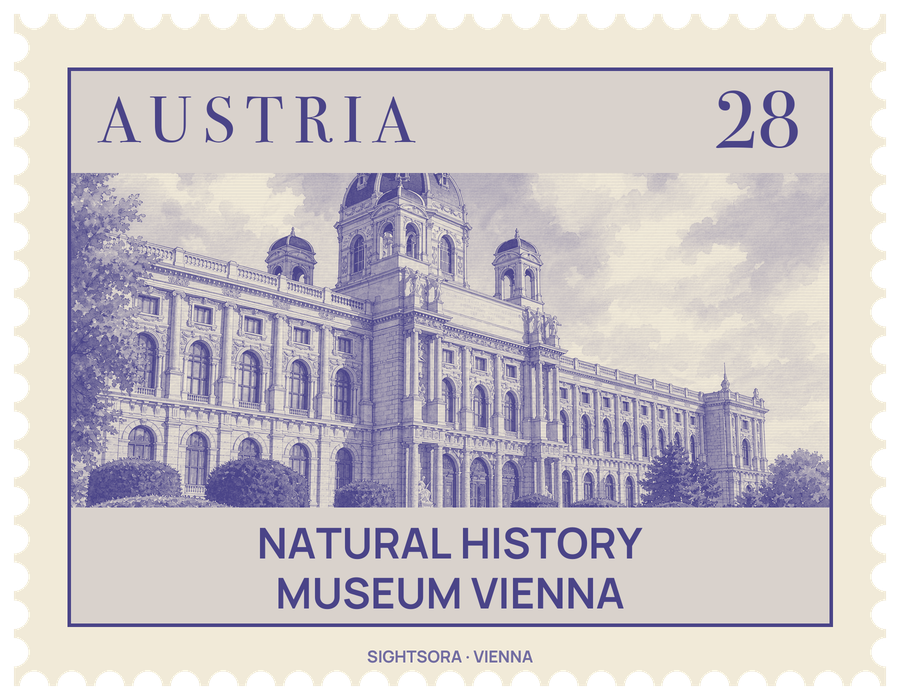
Both buildings were commissioned by Emperor Franz Joseph I and designed by Gottfried Semper and Carl Hasenauer as part of an Imperial Forum that was never fully built. Under the dome, an imperial dedication in gold letters offers the house "Dem Reiche der Natur und seiner Erforschung", to nature and the study of it, and Franz Joseph opened it himself on 10 August 1889.
The collections are much older than the building, going back more than 250 years. In 1750 Emperor Francis I, husband of Maria Theresa, bought the natural history cabinet of the Florentine scholar Jean de Baillou, some 30,000 fossils, shells, corals, minerals and gems, and after his death Maria Theresa opened it to the public. Expeditions added much more: to Brazil from 1817, around the world on the frigate SMS Novara between 1857 and 1859, and northward with the Austro-Hungarian North Pole expedition, whose crew discovered Franz Joseph Land in 1873. Today the museum looks after tens of millions of objects and is also a major research institution.
The building is around 170 metres long and 70 metres wide, arranged around two courtyards, and its 65-metre dome carries a large bronze statue of Helios, the Greek sun god. Figures on the façade stand for the forces of nature and the progress of science, and sculptures of researchers line the balustrade. Over the grand staircase, Hans Canon's ceiling painting The Circle of Life covers 100 square metres with an allegory of the rise and fall of humanity, centred on a man in a red cloth holding an hourglass.
Inside, 39 halls are still laid out on a 19th-century plan, many with their original dark carved display cases. The mezzanine covers minerals, geology and palaeontology, prehistory and anthropology, decorated with more than 100 oil paintings that illustrate the exhibits. The first floor runs through the animal kingdom from the simplest forms onward, ending with the apes, and a Microtheater in Hall 21 shows the smallest organisms on Earth.
The mineral halls show rocks, ores, gems, meteorites and building stones gathered over more than 500 years. Hall IV holds the gem collection, where raw stones are displayed beside cut ones and finished jewellery, and a rhinestone replica of the Florentine Diamond, the original copy made in 1865, is kept here too. Among the larger pieces is an amethyst of about 450 kilograms from the Serra do Mar in Brazil, a gift of the patron Isidor Weinberger.