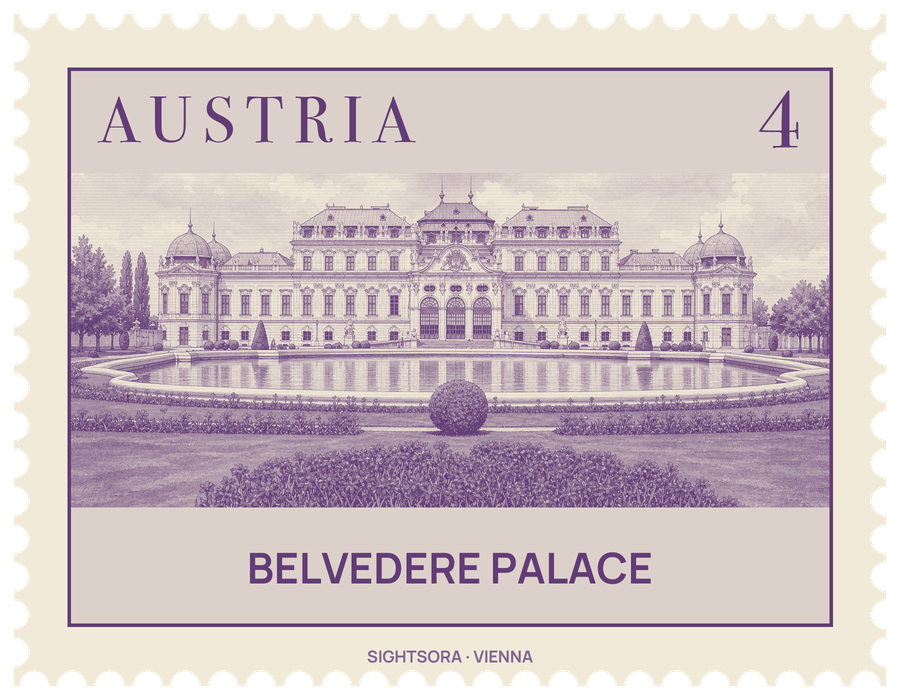
Prince Eugene of Savoy had them built as his summer residence after his campaigns against the Ottoman Empire, with Johann Lukas von Hildebrandt as architect, and the Upper Belvedere was completed in 1723. Today the ensemble is a major art museum whose Austrian holdings run from the Middle Ages up to the present day, and it forms part of the Historic Centre of Vienna World Heritage Site.
The Upper Belvedere holds the permanent collection, shown under the title Picture this! and stretching across some eight hundred years, from Cranach to Lassnig. Its most famous painting is Gustav Klimt's The Kiss, part of a large group of works by Klimt, and the rooms also show Egon Schiele, Oskar Kokoschka, Ferdinand Georg Waldmüller and the sculptor Franz Xaver Messerschmidt, with Rodin, Monet and van Gogh among the artists from outside Austria. The palace was designed for ceremony rather than daily living: the Marble Hall has a ceiling fresco by Carlo Innocenzo Carlone, painted between 1721 and 1723, and the Sala Terrena below has a vault carried on four Atlas figures, added by Hildebrandt in the winter of 1732–33. At the Upper Belvedere the Austrian State Treaty was signed on 15 May 1955, restoring Austria as an independent state after the Allied occupation.
The Lower Belvedere, begun by 1712, was the prince's pleasure palace beside the gardens and is used for temporary exhibitions, as is the neighbouring Orangery, converted into a modern gallery by Susanne Zottl. Its Baroque state rooms, including the Marble Gallery, the Golden Room and the Hall of Grotesques, can be visited. A third venue, Belvedere 21, shows contemporary art, film and music from Austria and abroad and has its own cinema, the Blickle Kino.
Between the two palaces, Dominique Girard, trained in the gardens of Versailles, laid out the garden in the French manner on three broad terraces, with symmetrical parterres, water basins, cascades, steps, clipped hedges and sculptures whose mythology links the prince to the god Apollo. From the top, the view back over the gardens to the city centre is the scene Bernardo Bellotto painted in View of Vienna from the Belvedere, known as the Canaletto Blick. After Eugene's death in 1736 the complex passed to Maria Theresa in 1752; from 1896 the Upper Belvedere was the official home of Archduke Franz Ferdinand as heir to the throne.