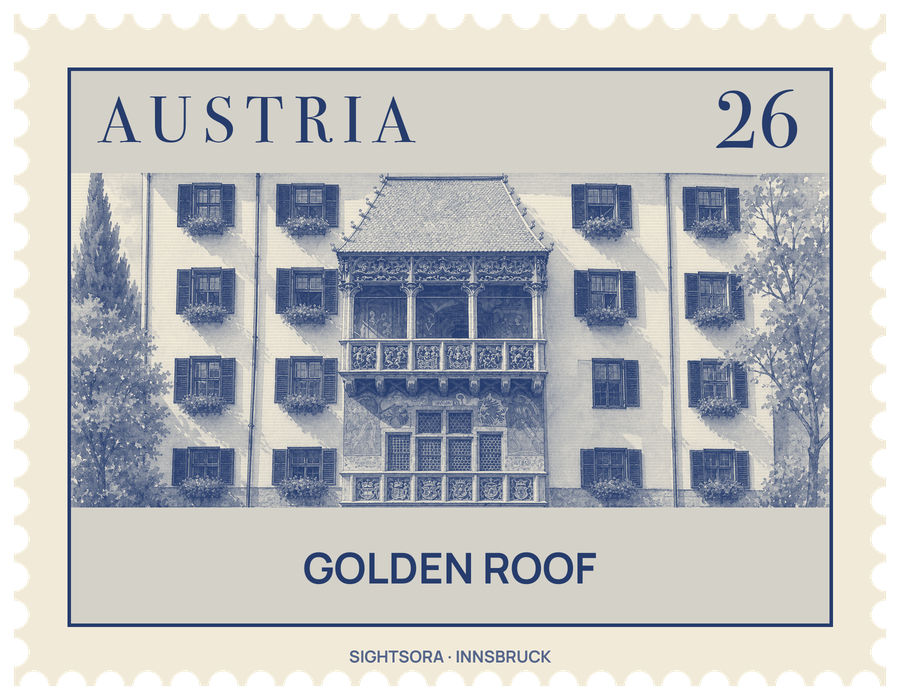
Emperor Maximilian I ordered the loggia in 1493, the year he married Bianca Maria Sforza of Milan, and it was finished in 1500. From it the emperor and his court watched the tournaments, festivals and other spectacles held in the square, much as from a royal box at a theatre.
The house behind it is older: Archduke Friedrich IV built it in the early 15th century as the residence of the rulers of Tyrol. The court builder Nikolaus Turing the Elder designed the loggia and its gilded roof. Every surface of the oriel carries carved reliefs or wall paintings, and Jörg Kölderer painted both the outer frescoes and the scenes of courtly life inside the loggia in 1500.
Reading from the bottom, the first-floor balustrade has eight carved coats of arms standing for Maximilian's lands, six on the front and one on each side, with Kölderer's two knights carrying the banners of the Holy Roman Empire and Tyrol painted above them. On the second-floor balustrade, eight reliefs show scenes from the emperor's life. In one of the two central panels Maximilian stands between his second wife, Bianca Maria Sforza, holding an apple, and his first wife, Maria of Burgundy; in the other he appears with his chancellor and his court jester. The outer panels show Moorish dancers in the acrobatic style of the time.
What visitors see on the façade are careful copies: the original reliefs can be seen in the Ferdinandeum, the Tyrolean State Museum, where they are shown permanently. The building itself contains the Maximilianum museum and the Innsbruck City Archives.