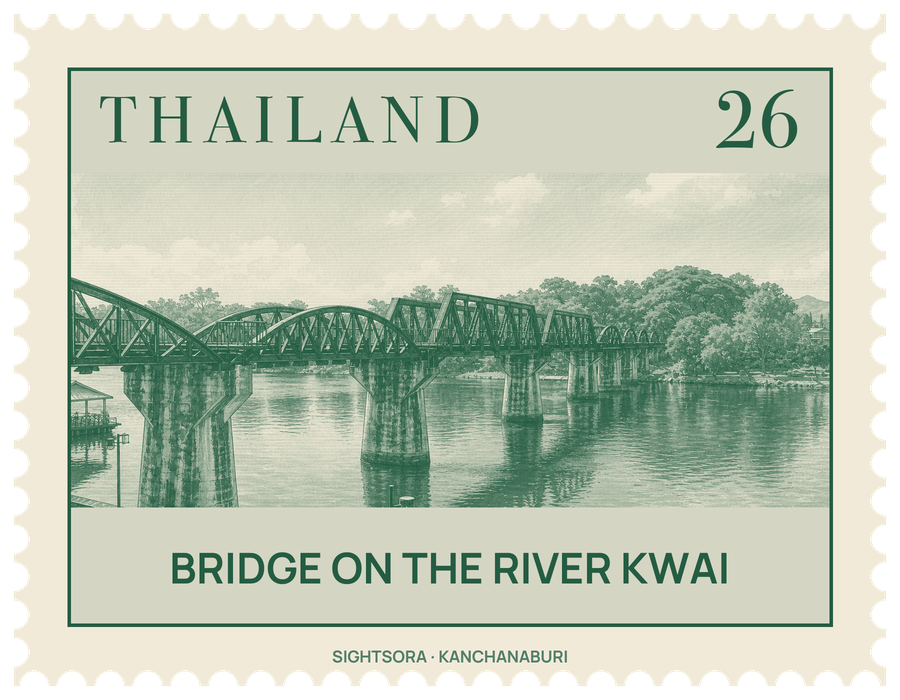
Allied prisoners of war and Asian labourers built it in 1942–1943 for the Burma Railway, the Japanese line between Thailand and Burma that came to be called the Death Railway, a name earned by the many prisoners and forced workers who died on it.
British prisoners reached the Tamarkan camp on 26 October 1942 to start work on the bridge; around 1,000 of them worked under Colonel Philip Toosey, and in February 1943 another 1,000 Dutch prisoners arrived, alongside Chinese, Malay and Tamil civilians. A wooden railway bridge was finished in February 1943 and a steel and concrete one in June 1943, put together from eleven curved-truss spans the Japanese had brought from Java. Unlike the collaborating colonel of the novel, Toosey slowed the work wherever he could: termites were gathered to eat the wooden structures and concrete was mixed badly on purpose.
Allied aircraft attacked the bridges several times in 1945, and each time forced labourers repaired them, until on 24 June 1945 the RAF destroyed them and put the line out of action for the rest of the war. After the war, the two curved spans that had fallen were replaced by angular truss spans that Japan supplied as part of its reparations, which gives the bridge its present mix of rounded and straight-sided sections.
The human cost of the railway was terrible. Many thousands of prisoners of war and tens of thousands of Asian civilian labourers died building it, most of the civilians conscripted in Thailand and Burma or forcibly taken from Malaya and the Dutch East Indies. Three cemeteries kept by the Commonwealth War Graves Commission hold the Allied dead: Kanchanaburi War Cemetery, in the town, has the graves of 6,982 Allied servicemen, and Chungkai War Cemetery nearby a further 1,693. Kanchanaburi also has two museums devoted to the railway, the Thailand-Burma Railway Centre and the JEATH War Museum, and at the bridge itself there is a memorial plaque and a wartime steam locomotive on display.
Pierre Boulle's novel and the film made from it are largely fiction. When the bridge was built, the river beneath it was part of the Mae Klong; the British called the railway's river valley the 'Kwai', a mispronunciation of the Khwae Noi, and when visitors began arriving to see the bridge from the film, Thai authorities renamed this stretch of the river the Khwae Yai in the 1960s.
Getting there
The bridge is at Tha Ma Kham, 5 kilometres from Kanchanaburi, on the section of the old line that was rebuilt after the war; trains run on it as far north as Nam Tok.