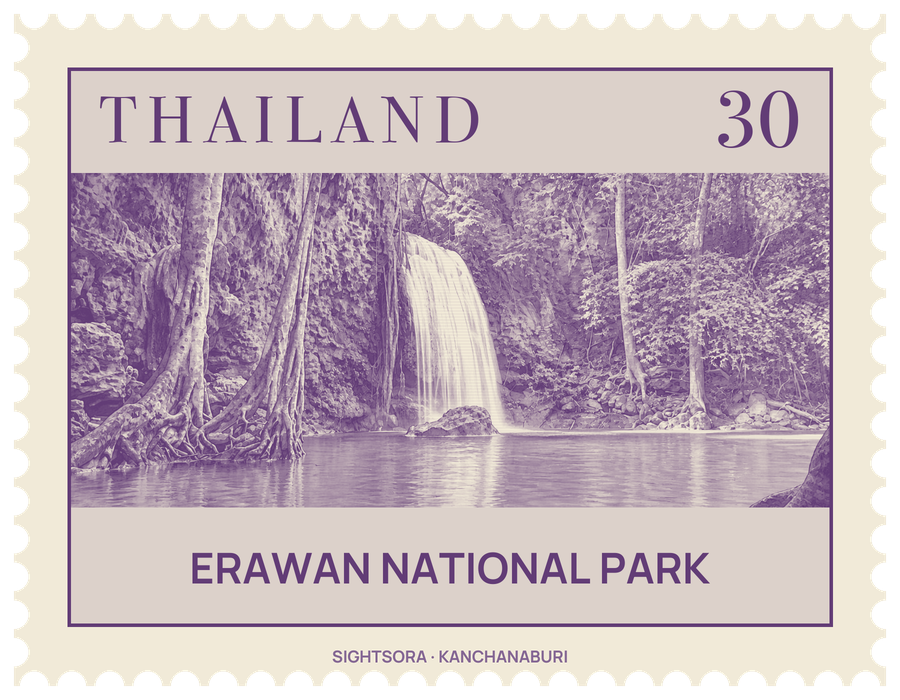
The three spouts are said to resemble the three heads of Erawan, the white elephant of Hindu mythology, and the falls and park are named after it. Its Royal Gazette proclamation of 19 June 1975 made it the 12th national park of Thailand, and its boundaries were revised in 1995.
A trail from the park visitor center climbs beside the river past the first six tiers; it is 1.5 km from the trailhead to the top tier. All along the way the water collects in pools and ponds, which are full of Garra rufa, the small fish also called doctor fish. The falls are fed by the Huai Monglai and Huai Amatara streams.
The park spreads over about 550 square kilometres of limestone mountains rising to 996 metres, among them Khao Chong Pun and Khao Plai Dinsor, and shares borders with the Salak Phra Wildlife Sanctuary and with the Sai Yok and Khuean Srinagarindra national parks. Northeast of the falls rises Khao Nom Nang, a hill named for its breast-like shape. The park has four caves, named Rua, Mi, Phra That and Wang Badan; the 544-metre Phra That cave is reached by a concrete path from the Ranger's Station, west of the visitor center.
Sitting in the rain shadow of the hills, the park receives fairly little rain, and most of it is covered by mixed deciduous forest, with smaller areas of dry evergreen and dry dipterocarp forest. Around 237 bird species from 64 families have been counted here, including the black-throated laughingthrush and the scarlet-backed flowerpecker, along with mammals such as the southern pig-tailed macaque.