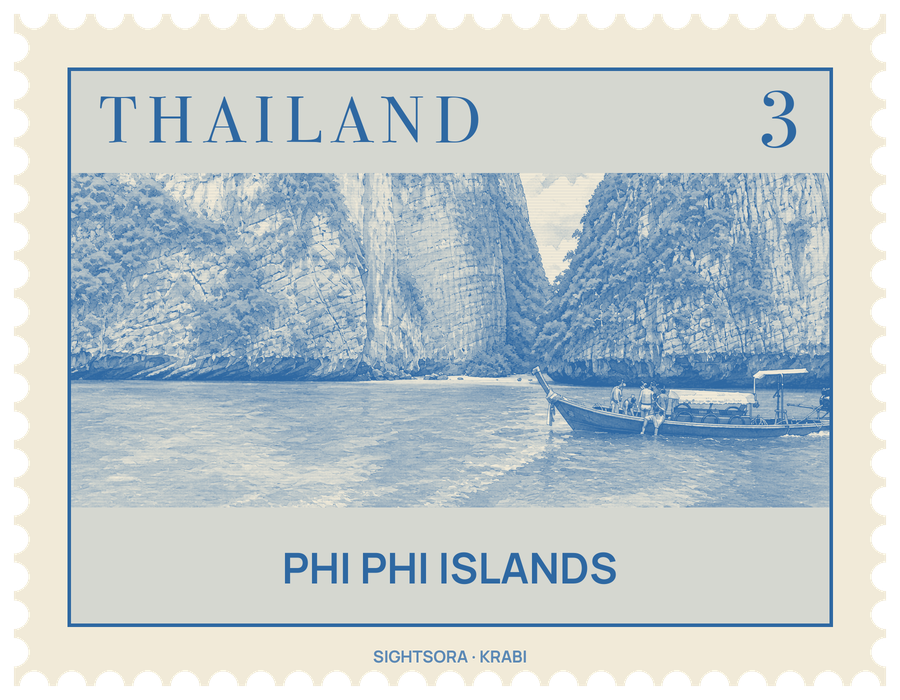
Cliffs, caves and long white sand beaches line their shores, and the surrounding water is rich in coral and marine life. Their name comes from the Malay Pulau Api-Api, "the fiery isle", after the grey mangrove known as the fiery tree that grows here.
Only two of the islands are lived on or widely visited. Ko Phi Phi Don, about 8 kilometres long and 3.5 kilometres wide, holds almost all the people; it was settled by Thai Malay fishermen in the late 1940s and later planted with coconuts. Its main village, Ton Sai, sits on a low sandy isthmus between two tall limestone ridges, with curved beach-lined bays on either side: Ton Sai Bay and Loh Dalum Bay. Ko Phi Phi Le, much smaller, draws visitors to its beaches, and the rest of the group, such as Ko Mai Phai, Bida Nai and Bida Nok, amounts to little more than big rocks standing in the sea.
Phi Phi Le became known around the world after it served as a location for the 2000 film The Beach, and the rise in tourism that followed brought damage to the environment. Its Maya Bay was the film's beach. The same island holds the Viking Cave, where edible bird's nests are harvested.
On 26 December 2004 the Indian Ocean tsunami struck Phi Phi Don from both bays at once, the waves meeting in the middle of the isthmus, and about 70% of the island's buildings were destroyed. A volunteer group, Help International Phi Phi, set up by former resident Emiel Kok, brought back staff from the refugee camp and thousands of backpacker volunteers to clear the island, while Phi Phi Dive Camp removed debris from the bays and reef. Ton Sai was rebuilt, and a tsunami early-warning system was installed with volunteers' help.
Getting there
Ferries, speedboats and long-tail boats run to the islands, usually setting out from Krabi town or from one of Phuket Province's ports; frequent ferries also come from Ko Lanta. Boats arrive at the government deep-water pier on Tonsai Bay, beside Phi Phi Don Village. Krabi has the nearest airport, with Phuket and Trang airports also close.