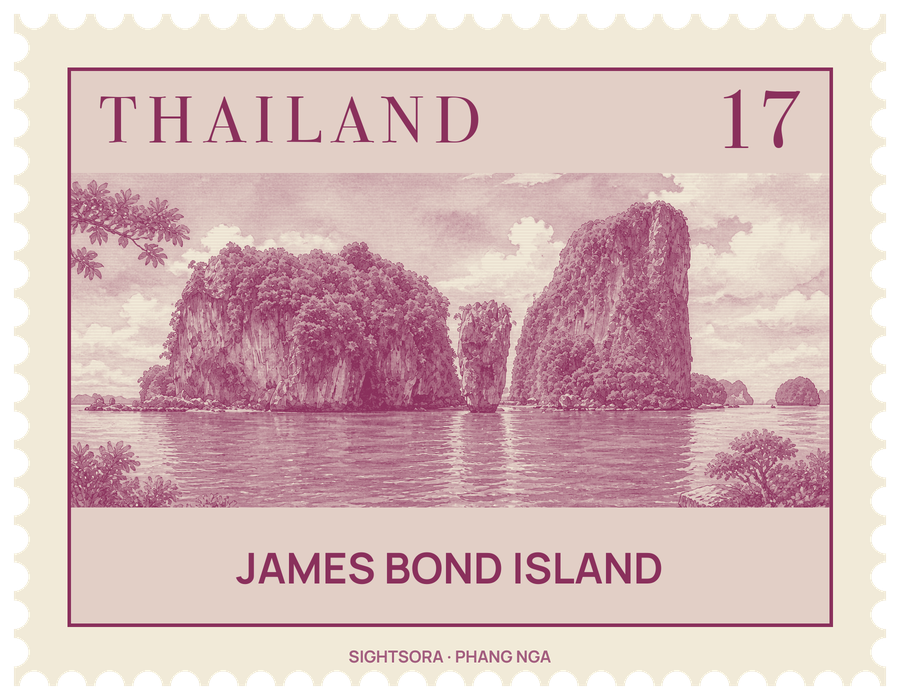
Forty metres or so from their shore stands Ko Ta Pu, a 20-metre pillar of rock that is narrower at the waterline than at its crown. Both appeared on screen in The Man with the Golden Gun, the James Bond film of 1974, and ever since, the islands and the pillar, together or separately, have gone by the name James Bond Island; locals seldom use the original names. They belong to Ao Phang Nga National Park.
In Thai, Khao Phing Kan translates as "hills leaning against each other", and it describes what visitors see: a flat slab of limestone that seems to have toppled sideways and come to rest against a second rock in the middle of the island. Ko Tapu, the other name, can be read as "nail" or "spike", after the pillar's shape. A local legend tells of a fisherman who kept hauling up a nail instead of fish, cut it in two with his sword in anger, and watched one half jump into the sea to become the rock. Geologists explain it differently: the area was a barrier reef in the Permian period, later broken apart by tectonic movement, drowned by rising seas and carved by wind, waves and tides, whose wear is clearest at the base of the pillar.
Tourist boats from the mainland land on the beach that lies between the twin islands, where stalls sell shells, coral and insects set in plastic; a second sandy beach lies on the southwest side. The islands have several caves, but with a tidal range of 2–3 metres the beaches and caves flood regularly, and some caves can only be entered at low tide. The western island is around 130 metres across, and the eastern one stretches about 240 metres, mostly northward.
In the film the pillar was the hideout of the villain Francisco Scaramanga, described as a "mushroom-shaped rock" fitted with solar panels; it later turned up again in Tomorrow Never Dies, standing in for Vietnam, and in the Italian comedy Quo Vado?, standing in for the Philippines. Before 1974 the island had seen little outside attention, and the tourist boom that followed brought litter and damage; in 1981 it was taken into the new marine national park to protect it.
Pandanus, cycads and euphorbs cling to the almost soil-free cliffs, including those of Ko Ta Pu, rooting in the cracks and living on rainwater, while the rest of the island is covered in limestone shrubland and evergreen trees. Rivers and mangroves feeding the bay make the warm shallows rich in plankton, and the waters around hold reef fish such as butterflyfish, crabs, cuttlefish, moray eels and soft corals. More than 100 bird species have been recorded in the area, among them the striated heron, the Pacific reef heron and the little egret.