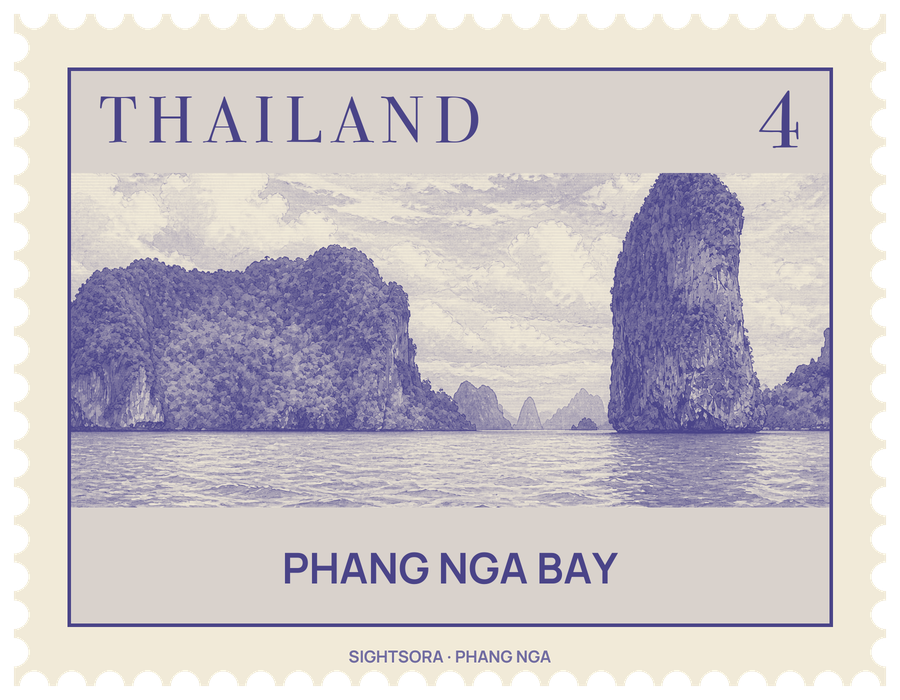
The sea has flooded a range of karst hills to leave 42 islands with high cliffs, overhangs and caves, fringed on the mainland side by wide mangrove forest. Since 1981 a large part of the bay has been protected as Ao Phang Nga National Park, about 400 square kilometres in Phang Nga Province, and in 2002 it was also listed as a Ramsar wetland of international importance.
The best-known pair of islands is Khao Phing Kan and Ko Ta Pu, nicknamed James Bond Island: Khao Phing Kan served as the villain's base in The Man with the Golden Gun (1974), and the needle of Ko Ta Pu stands 20 metres off its main beach. Ko Ta Pu returned in Tomorrow Never Dies in 1997, with the bay doubling for Ha Long Bay in Vietnam, and Revenge of the Sith, the third Star Wars episode, used the bay for Kashyyyk, home planet of the Wookiees.
The limestone took shape between the Cretaceous and the early Tertiary, and faults and later changes opened the many caves and holes in it. Sea levels have swung widely since: around 10,000 years ago, when the sea was lower, Phuket and Krabi were linked by dry land. People have lived here a long time; caves and islands hold archaeological sites with paintings more than a thousand years old, and in 1987 prehistoric burials were found at Khao Tao.
The mangroves include at least 28 species, among them Rhizophora apiculata and Bruguiera, and give way inland to beach forest and tropical forest, with seagrass beds and coral in the water. A 1991 wildlife count found 17 mammal, 88 bird and 18 reptile species. Birds include the white-bellied sea eagle, the Brahminy kite and the Pacific reef heron, while dugong, smooth-coated otters and crab-eating macaques also live in the park. Villages such as Ao Luk still fish and cut Nypa palm fronds for thatch alongside the tourism the bay draws.