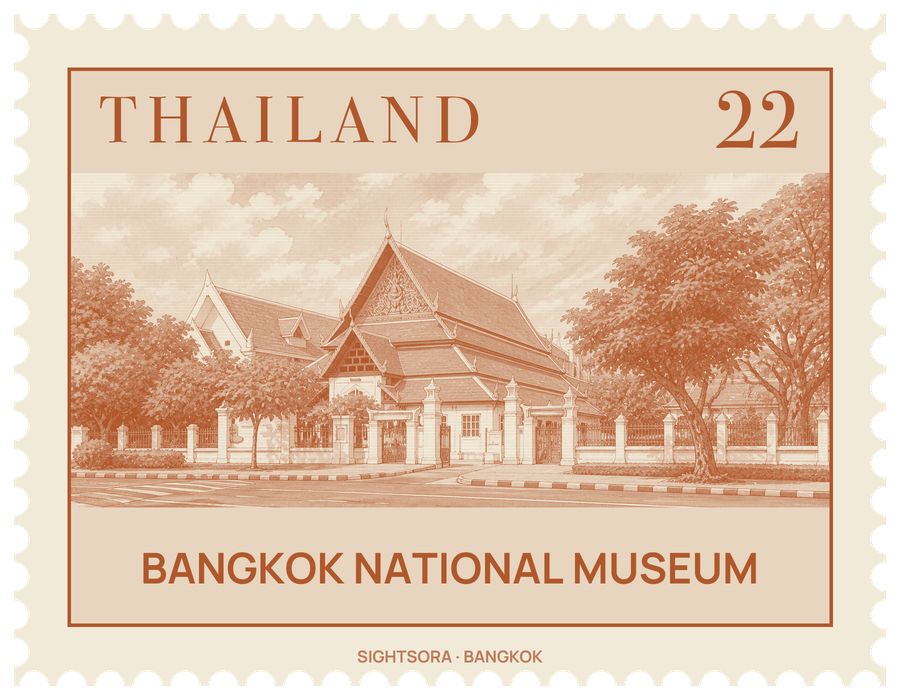
It is the main branch of Thailand's national museums, and its galleries follow Thai art and history from Neolithic times onwards, alongside Buddhist art from across Asia.
The museum grew out of the antiquities gathered by King Mongkut. His son, King Chulalongkorn, opened a first public museum for them in the Concordia Pavilion of the Grand Palace on 19 September 1874, the date the Fine Arts Department treats as the birth of the national museum. After Chulalongkorn abolished the post of vice king, he had the collection moved into the empty Front Palace in 1887 as the Wang Na Museum. It was renamed the Bangkok Museum in 1926 and came under the Fine Arts Department in 1934.
The Thai History Gallery, at the front of Siwamokhaphiman Hall, displays the Ram Khamhaeng Inscription, a stone that describes early Thai script, government, religion and society; it was entered in UNESCO's Memory of the World Register in 2003. The hall began as an audience hall, put up when Rama I's Prince Successor, Maha Sura Singhanat, built the Front Palace. At its rear, the Prehistory Gallery covers the country's earliest cultures, while in the North Wing Building the Art History Gallery traces sculpture from the Dvaravati, Srivijaya and Lopburi periods to the early Bangkok period of around 1782. Beyond Thai work there are Buddhist pieces from Gandhara, the Tang, the Cham, Java and the Khmer.
The old central palace buildings hold the decorative arts and ethnology collections: gold and gemstones, mother-of-pearl inlay, royal insignia, costumes and textiles, ceramics, carved ivory, weapons, musical instruments and royal conveyances, among them the Great Victory Royal Chariot that King Rama I commissioned in 1795. The Buddhaisawan Chapel dates from 1787, when it was raised for the Phra Phuttha Sihing, an important Buddha image, and it has murals of the life of the Buddha inside. The museum also keeps a group of large Hindu bronzes, among them two standing Śiva figures measuring 308 and 150 centimetres, whose dating has been argued over since the 19th century.
In May 2024 two bronzes sent back by New York's Metropolitan Museum of Art were unveiled at the museum after about three decades abroad: the Golden Boy, a figure 4 feet tall made around 900 years ago, and the Kneeling Lady. Both are thought to come from the lower Northeast, perhaps the area of today's Buriram province, and belong to the Khmer art of the 11th and 12th centuries.