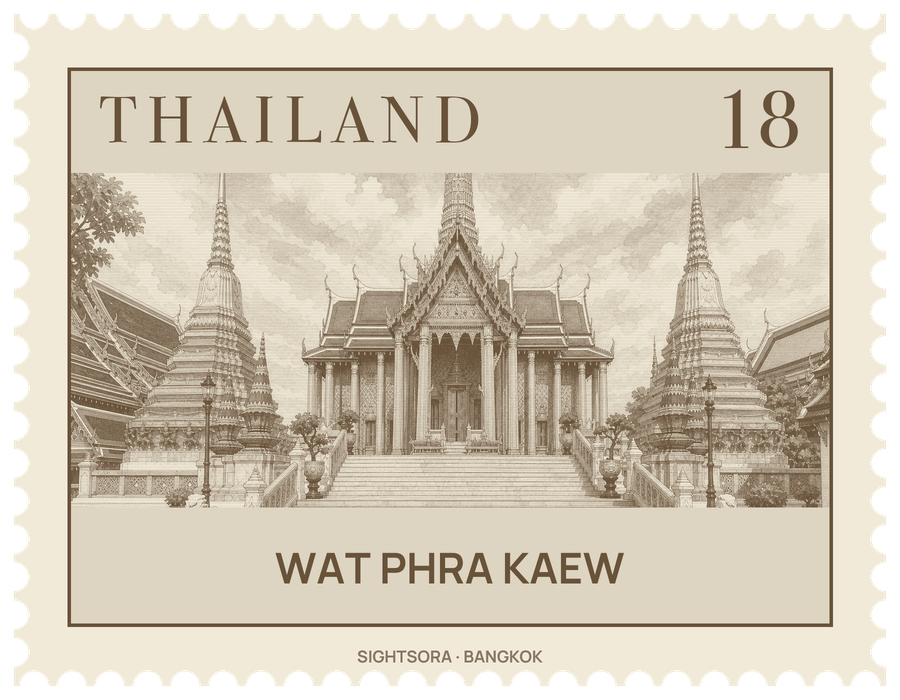
The image, formally Phra Phuttha Maha Mani Rattana Patimakon, is venerated as the palladium of the nation, and the temple around it, officially Wat Phra Si Rattana Satsadaram, is the royal temple where coronations, royal ordinations and the investiture of the supreme patriarch take place. As a chapel inside the palace, it has no living quarters for monks; monks from other temples come to perform the rites.
Rama I, founder of the Chakri dynasty, began the temple in 1783, the year after he made Bangkok his capital, taking Wat Phra Si Sanphet beside the royal palace of Ayutthaya as a model. The Emerald Buddha, which he had taken from Vientiane in 1779, was carried over the river from Wat Arun with great ceremony in 1785. Every king since has added to the temple, restored it or donated treasures to it, with major renovations for the city's anniversaries in 1832, 1882, 1932 and 1982. Three times a year, at the turn of the seasons, a royal ceremony changes the image's gold garments.
The ordination hall, or ubosot, which houses the image, fills almost the whole southern part of the complex behind a low wall set with eight small spired pavilions holding gilded boundary stones. Its roof of blue, yellow and orange tiles is hung with hundreds of little gilded bells, and its pediments show Narayana riding Garuda, the emblem of kingship. Around the base run one hundred and twelve gilded Garudas gripping serpents, and twelve bronze lions guard the steps; of the six doors inlaid with mother-of-pearl, the larger central one is reserved for the king. Inside, murals cover every wall: the earth goddess Phra Mae Thorani wringing out her hair to drown the demon Mara's army over the main door, Buddhist cosmology behind the image, and royal processions by land and by water along the lower walls.
Elsewhere in the complex, a raised terrace carries three great structures in a row. At the west end, the Phra Si Rattana Chedi is a bell-shaped stupa covered in gold-coloured tiles that Rama V brought from Italy, holding relics of the Buddha from Sri Lanka. In the middle, the Phra Mondop is the library, built by Rama I to keep the Tripitaka he had revised after Ayutthaya fell; inside, a mother-of-pearl cabinet stands on a floor covered with a woven silver mat. At the east end, the Royal Pantheon, Prasat Phra Thep Bidon, was meant by Rama IV for the Emerald Buddha but was rebuilt after a fire in 1903 and became a memorial to the Chakri kings, with lifelike statues of them. Next to the library sits a detailed model of Angkor Wat, made after Rama IV's idea of bringing an actual Khmer temple to Bangkok proved unworkable.
Along the eastern wall stands a row of eight prang, slim towers clad in coloured porcelain, each in its own colour and each dedicated to an aspect of Buddhism, from the white one for the Buddha to the yellow one for Maitreya, the future Buddha. A covered gallery runs right round the temple like a cloister, its walls painted with the whole Ramakien epic, the Thai version of the Ramayana, in 178 scenes; the sequence starts to the right of Gate No. 7.
The temple wall has seven gates, and six of them are watched over by pairs of yaksha, giants from the Ramakien about 5 metres tall, each leaning on a mace and told apart by skin colour and crown, from red Suriyaphop to green Thotsakan with tiers of small heads on his crown. Behind the ubosot sits a bronze image of the hermit Jivaka Komarabhacca with a large grinding stone in front of him, on which traditional healers once prepared their medicines.