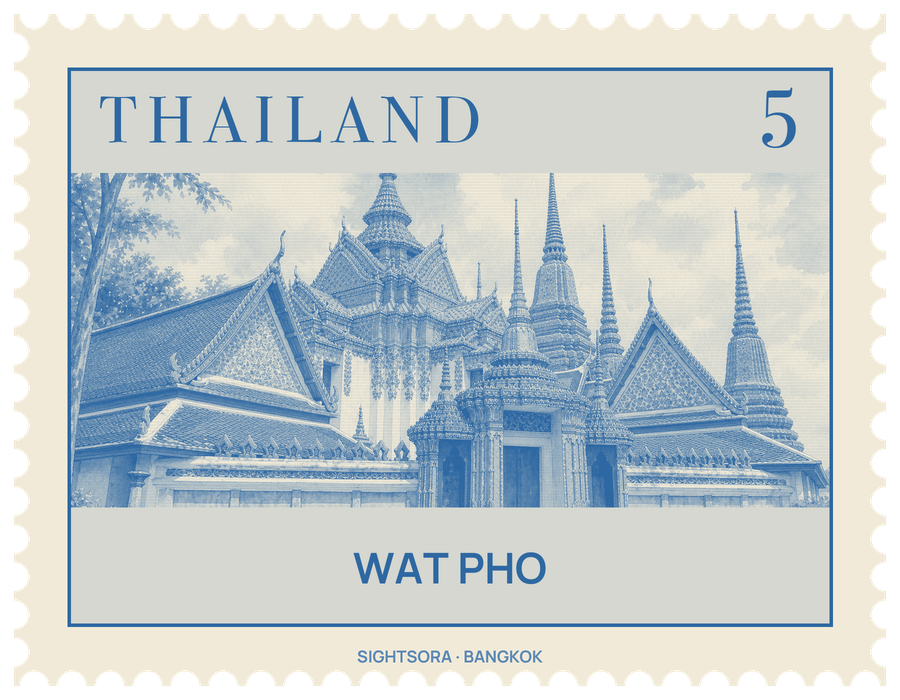
The temple is older than Bangkok itself; its earlier name, Wat Photaram, recalls the Bodhi tree monastery at Bodh Gaya. King Rama I rebuilt it from 1788 as his main temple, and some of his ashes are enshrined here. It heads the list of six temples ranked in the highest grade of first-class royal temples, holds more than one thousand Buddha images, and is regarded as Thailand's earliest centre of public education and the birthplace of traditional Thai massage.
Most of what stands today was built or rebuilt under Rama III, who from 1832 enlarged the complex over 16 years and seven months. He turned the temple into a public school in stone: granite slabs engraved with texts and pictures on history, medicine, custom, literature, proverbs and the Buddhist religion were set around the grounds, and in 2008 these marble illustrations and inscriptions were registered in UNESCO's Memory of the World Programme. Chetuphon Road divides the complex into two walled compounds; the northern one, the phutthawat, holds the main buildings and is open to visitors, while the southern one, the sankhawat, houses the monks and a school.
The reclining Buddha, Phra Buddhasaiyas, lies in its own hall built by Rama III in an Ayutthaya style, and shows the Buddha entering Nirvana in the pose of a reclining lion. Its brick core is shaped in plaster and gilded, and the head rests on two box-pillows set with glass mosaic. The soles of the feet, 3 metres high and 4.5 metres long, are inlaid with mother-of-pearl in 108 panels of auspicious symbols such as flowers, dancers, white elephants and tigers. Along the corridor stand 108 bronze bowls, into which visitors drop coins for good fortune. Beside the hall, a small raised garden has a bodhi tree propagated from Sri Lanka's Jaya Sri Maha Bodhi.
The ordination hall, Phra Ubosot, is the most sacred building. It stands on a marble platform within a double cloister, its teak doors inlaid with mother-of-pearl scenes from the Ramayana, and inside a gilded Buddha, Phra Buddha Theva Patimakorn, sits on a three-tiered pedestal of gold and crystal beneath a nine-tiered umbrella; Rama IV placed ashes of Rama I under the pedestal. Around the outside runs a balustrade of 152 marble panels carved in 1831 with battle scenes from the Ramakien. The cloister is cut by four viharns, each with its own Buddha; the eastern one holds the 8-metre standing Buddha Lokanatha from Ayutthaya, and the western one a seated Buddha sheltered by a naga.
Nearby rise the Phra Maha Chedi Si Rajakarn, four stupas each 42 metres high, one for each of the first four Chakri kings. The green one was built by Rama I to encase what was left of Phra Phuttha Sanphet, a huge bronze standing Buddha brought from Ayutthaya; Rama III added a white one for the ashes of Rama II and a yellow one for himself, and Rama IV built the blue fourth and walled the group in. Elsewhere stand 91 small chedis, Chinese stone statues that came as ballast on trading ships, including some showing Europeans, and 24 small rock gardens, one of them, the Contorting Hermit Hill, with figures in massage and yoga poses.
The temple's school of traditional medicine and massage still teaches Thai pharmacy, medical practice, midwifery and massage here, and two pavilions on the eastern edge of the compound serve as classrooms where visitors can also have a massage. Nuad Thai, the massage taught at Wat Pho, is on UNESCO's list of Intangible Cultural Heritage. Around the complex, 60 inscribed plaques, 30 for the front of the body and 30 for the back, map the pressure points used in the practice.