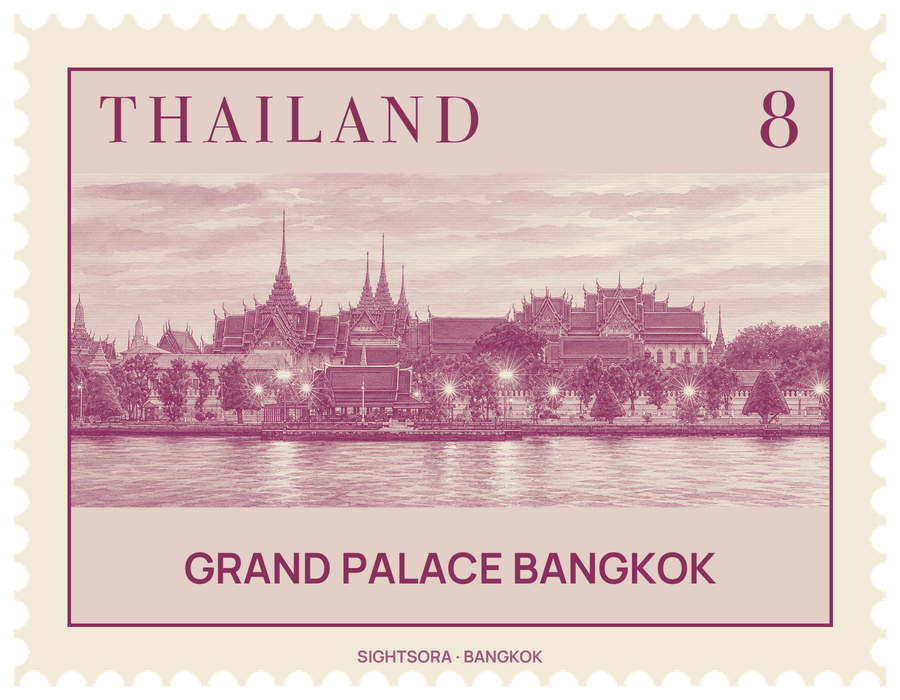
King Rama I, founder of the Chakri dynasty, ordered it begun on 6 May 1782, when he moved the capital across the river from Thonburi, and since then it has served as the official residence of Siam's kings and later of Thailand's. The king, his court and the government lived and worked inside its walls until 1925; today the kings reside elsewhere, but royal ceremonies and state functions are still held here.
The first palace was built of wood inside a log palisade, and over the following years it was rebuilt in masonry, partly with bricks taken by barge from the ruins of Ayutthaya, destroyed in 1767. Its plan copied the old royal palace at Ayutthaya, with separate courts, walls, gates and forts, a landing stage on the river and the great field of Sanam Luang to the north for ceremonies. Successive kings added and rebuilt for over 200 years, which explains the palace's mix of styles and its lack of symmetry. Castellated white walls 1,910 metres long enclose it, pierced by 12 gates topped with prang spires and red doors, and guarded by 17 small forts.
Inside, the palace falls into four courts. The Outer Court in the northwest, entered through the main Wiset Chaisri Gate, held ministries, the royal mint and an arsenal, and now houses offices of the Royal Household and a small Pavilion of Regalia, Royal Decorations and Coins. To the left of the entrance lies the Temple of the Emerald Buddha, a royal chapel set within the palace walls. The Middle Court holds the state throne halls, and the Inner Court to the south, once a town of women with its own shops, schools and laws, numbering nearly 3,000 people, is closed to the public.
The Middle Court has three groups of halls in strikingly different styles. The Phra Maha Monthien, at the very centre, includes the Amarin Winitchai Throne Hall, where foreign envoys were received, its boat-shaped throne representing Mount Meru, and the Phaisan Thaksin hall where Chakri kings are crowned. The Chakri Maha Prasat Throne Hall, completed in 1882 by the English architect John Clunich for King Chulalongkorn (Rama V), sets Thai roofs and gilded spires over a European Renaissance body, a pairing often read as a statement against Western imperialism. The Dusit Maha Prasat, built under Rama I on a cruciform plan, rises in the shape of Mount Meru beneath a tall gilded spire, with a mother-of-pearl throne inside; it serves as the hall where royal remains lie in state.
Beside the Dusit Maha Prasat stands the Aphorn Phimok Prasat, a small open pavilion built by Rama IV as a robing place for the king, regarded as a model of Thai proportion and detail. In a former royal mint between the Outer and Middle Courts, the Museum of the Emerald Buddha Temple keeps architectural pieces removed in restorations, stone figures from the Ramakien, two models of the palace in the reigns of Rama I and Rama V, the seasonal robes of the Emerald Buddha and the Manangsila Throne brought from Sukhothai. The Queen Sirikit Museum of Textiles occupies the Ratsadakorn-bhibhathana Building on the palace grounds, opened after Queen Sirikit asked in 2003 to use the then-vacant building.