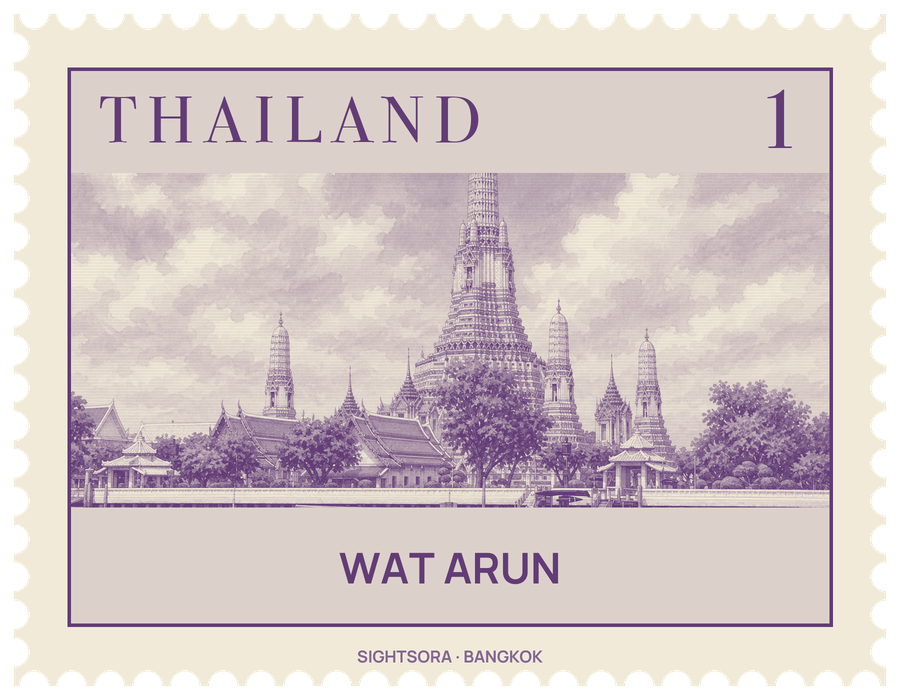
The name refers to Aruna, the Hindu charioteer of the sun god Surya, often pictured as the rays of the rising sun. Its design mixes Hindu and Buddhist symbolism with Siamese tradition, and although a temple has stood here since at least the 17th century, the great prang dates from the early 19th century.
Under the Ayutthaya Kingdom the temple was called Wat Bang Makok, after the village where it was built, and it already appears on French maps from the reign of King Narai (1656–88). After the fall of Ayutthaya, Taksin set up his capital at Thonburi beside it and renamed it Wat Chaeng; the temple then lay within the royal palace grounds, and it housed the Emerald Buddha until the image moved across the river to Wat Phra Kaew in 1785. Once Rama I shifted the palace to the eastern bank the temple was left empty, until Rama II restored it and planned a much higher main pagoda. Building went on under Rama III, and the main prang was finished in 1851 after nine years of work.
The central prang stands for Mount Meru of Hindu cosmology and is ringed by four smaller satellite prang at the corners, one of them dedicated to the wind god Phra Phai. Its surfaces are set with seashells and fragments of porcelain that ships from China once carried as ballast. Figures of ancient Chinese soldiers and animals line the base, statues of the god Indra riding Erawan stand on the second terrace, and a seven-pronged trident crowns the top. In Buddhist reading the tower has three levels: the base for all realms of existence, the middle for the Tavatimsa heaven and the summit for the six heavens.
Beside the prang is the Ordination Hall, which keeps a Niramitr Buddha image said to have been designed by Rama II, a grand altar faced with red, grey and white marble, and murals painted in the reign of Rama V. Two guardian demons from the Ramakien flank its entrance: the white Sahassa Deja and the green Thotsakan, the demon Rāvana of the Ramayana. Along the riverfront are six Chinese-style pavilions of green granite with landing bridges.
The prang has been restored several times, under Chulalongkorn (Rama V), in 1980 ahead of Bangkok's bicentenary, and most extensively from 2013 to 2017, when many broken tiles were replaced and lime plaster took the place of the cement used in earlier repairs. Photographs of the finished work drew some criticism for looking whitewashed; the Fine Arts Department answered that the work had been careful and aimed to bring back how the temple first looked.
Getting there
Wat Arun is reached by way of the Chao Phraya River; ferries cross the river towards the Maharaj pier.