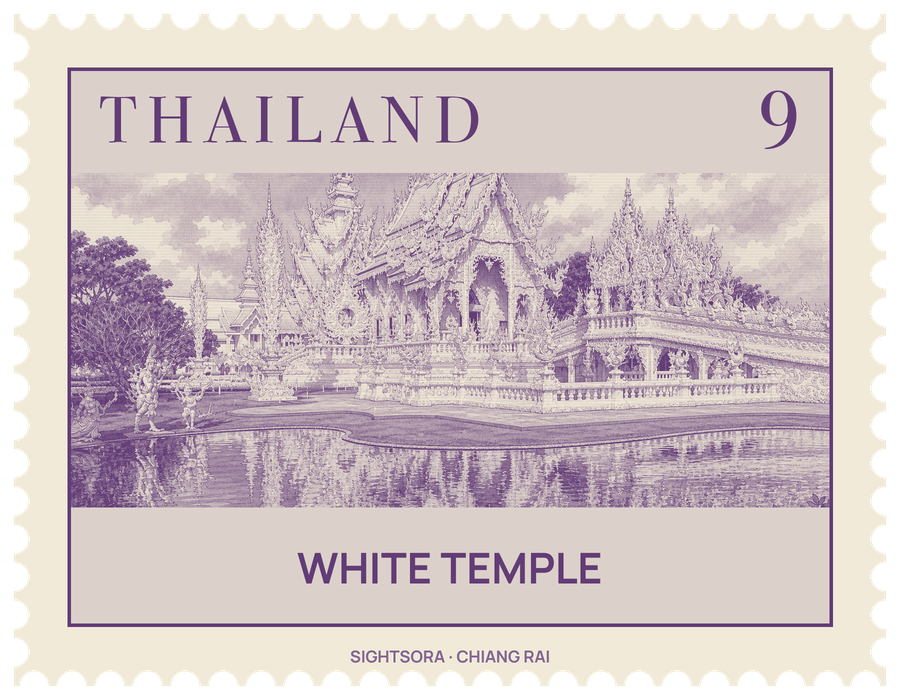
It is privately owned and is the creation of Chalermchai Kositpipat, a national artist from Chiang Rai, who designed and built it and opened it to visitors in 1997. From afar the buildings look as if they were made of porcelain; up close the shine turns out to come from whitewash and clear mirrored chips laid over a plain concrete frame with a wooden roof.
The temple that stood here before had fallen into poor repair by the end of the 20th century, with no money to restore it, and Chalermchai chose to rebuild it entirely, paying for the work himself. He regards the temple as an offering to the Buddha and means the ground around it to become a place of learning and meditation. The plan for the finished compound has nine buildings: beside the ubosot there are to be monks' living quarters, an art gallery, a meditation hall and a hall of relics.
The way to the main building is laid out as a lesson. In front of a bridge over a small lake, hundreds of reaching hands stand for unchecked desire, and the bridge itself is the path to happiness by giving up greed and temptation; two Kinnaree, half-human and half-bird, stand beside the lake. Across it, the "gate of heaven" is guarded by figures of Death and of Rahu, the judge of where the dead go next, with meditating Buddha images before the ubosot.
The ubosot follows classic Thai forms, with a three-tiered roof and many Nāga serpents, but inside the white gives way to murals of orange flames and demon faces mixed with figures from Western popular culture, such as Michael Jackson, Superman, Hello Kitty and a Terminator, alongside scenes of nuclear war, terrorist attacks and oil pumps. Nearby, a golden building stands out against all the white: it represents the body and the pull of money and worldly desire, while the white ubosot stands for the mind. The temple was damaged by an earthquake on 5 May 2014; after engineers found the buildings structurally sound, Chalermchai pledged to restore it.