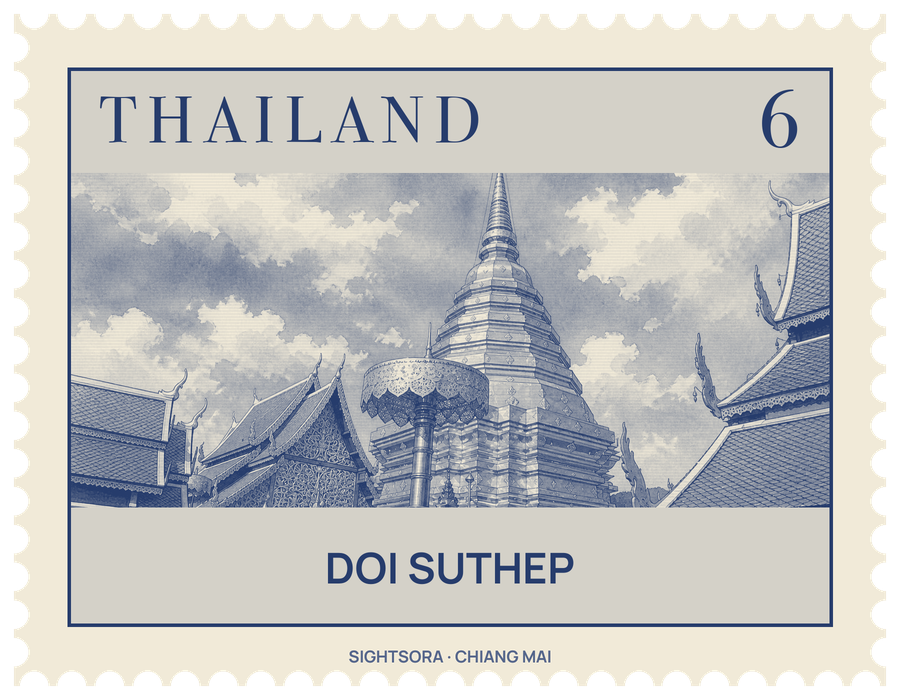
The temple is commonly called simply "Doi Suthep", after the mountain, and many Thai people hold it sacred. Its name itself describes it: phra marks an honoured Buddha image and that a relic. From the far side of the grounds visitors can look out over Chiang Mai.
The founding story survives as a legend told in several versions. In the best-known one, a monk from Sukhothai named Sumanathera brought a relic north to King Kue Na of Lan Na in 1368, and in what is now Lamphun it split in two. The smaller piece went to Wat Suan Dok; the larger was placed on the back of a white elephant and set loose. The elephant climbed the mountain, then known as Doi Aoy Chang, trumpeted three times and died, and the king took this as a sign to build a temple on the spot. The first stupa is said to date from 1383, and the temple has grown with many more shrines since.
A long stairway lined with Naga balustrades leads up from the car park, and at the top a statue of the white elephant recalls the legend. The chedi, 24 metres tall, is typical of northern Thailand, with a redented octagonal base, ringed and smooth sections of spire and a tiered umbrella, or chatra, at the top; the chatra came from two centuries of Burmese rule, while the rest shows strong Sukhothai influence. The relic lies in the rounded portion just above the octagonal base. Around it are pagodas, statues, bells, shrines and a museum, along with a Ganesh statue from Hindu tradition and a model of the Emerald Buddha.
The courtyard is laid out symmetrically around the chedi. With no water nearby, the main wihan faces the rising sun from the west side, and its two-tiered roof sets a flatter lower slope against a steep upper one, with ornamental Nagas at the corners and chofas at the peaks. Inside, the walls and columns lean towards the centre, the narrow trapezoid windows let in little light, and murals of the Buddha's life, with some Hindu elements, cover the walls among many Buddha statues. A cantilevered terrace on the edge of the mountaintop serves as the viewing point over Chiang Mai.
The road up the mountain was first built in 1935 under the monk Khruba Siwichai, a leading figure of northern Buddhism. In the 1980s a plan for a cable car to the temple raised a long debate over the pilgrimage climb and the sanctity of the site, and local opposition saw it dropped.
Getting there
A road climbs to the temple from Chiang Mai. From the car park below it, visitors either climb 309 steps or take a tram, and a funicular railway with a series of very steep ramps makes the temple accessible by wheelchair. Walkers can also hike up from the city on the Monk's Trail.