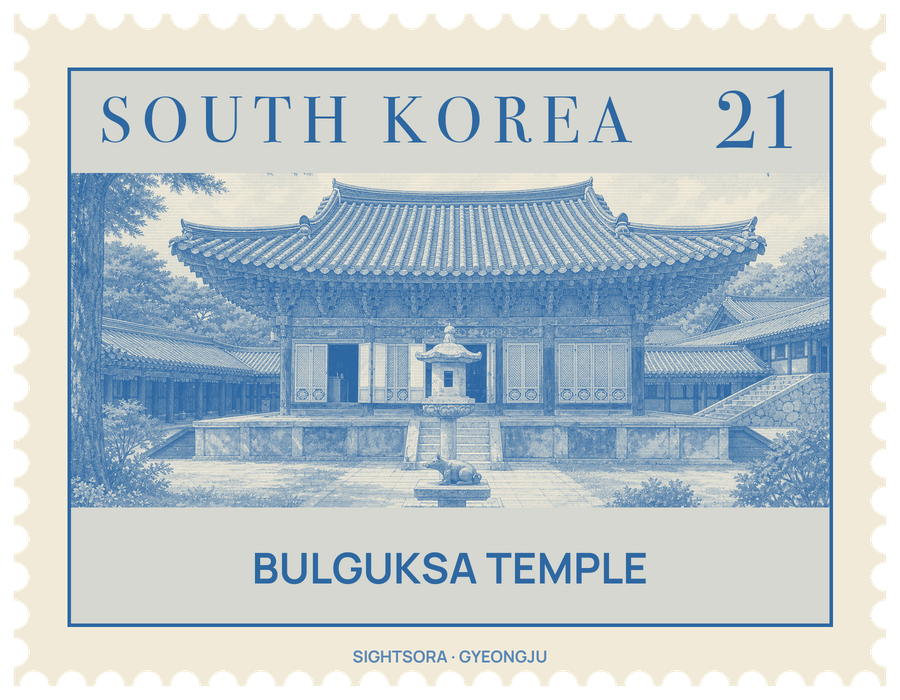
It was built under the Silla kingdom and is regarded as a masterpiece of that kingdom's golden age of Buddhist art; it holds six National Treasures, among them two stone pagodas, the Blue Cloud Bridge and two gilt-bronze Buddhas. UNESCO inscribed the temple on its World Heritage List in 1995, jointly with the nearby Seokguram Grotto, and the Jogye Order of Korean Buddhism counts it among its head temples.
Temple records place a small temple here in 528, under King Beopheung. The Samguk Yusa records that the present temple was begun in 751 under King Gyeongdeok by the chief minister Kim Daeseong, who wanted to pacify the spirits of his parents; after his death the Silla court completed it in 774 and gave it its name. Its wooden halls burned to the ground during the Imjin wars and were rebuilt and renovated many times from 1604, and an extensive restoration between 1969 and 1973 gave the temple its present form. The famous stonework survives from the original Silla construction. In 1966 a version of the Dharani sutra, printed from woodblocks between 704 and 751 on a scroll of mulberry paper 630 cm long, was found here.
The way in climbs a double stairway of 34 steps, matching the 34 steps to enlightenment: the lower White Cloud Bridge, Baegungyo, has 18 steps and the upper Blue Cloud Bridge, Cheongungyo, 16, with a semicircular stone arch beneath, and both lead up to the Jahamun gate. A smaller pair to the west, the Lotus Flower Bridge with lotus blossoms carved on each step and the Seven Treasures Bridge above it, leads through Anyangmun to the Hall of Supreme Bliss.
Beyond Jahamun, in the main courtyard before the main hall, Daeungjeon, stand the two pagodas, unusual in being a pair. Seokgatap, 8.2 metres tall and over 13 centuries old, is a traditional Korean stone pagoda of plain lines and little ornament; Dabotap, 10.4 metres tall, honours the Many Treasures Buddha of the Lotus Sutra and is as elaborate as its partner is simple. Hyun Jin-geon wrote a historical novel about their making, which became the 1957 film Shadowless Pagoda.
Daeungjeon, the Hall of Great Enlightenment, enshrines the Shakyamuni Buddha. Behind it is Museoljeon, the Hall of No Words, named for the belief that the Buddha's teaching cannot be passed on through words alone and among the oldest buildings of the complex. Gwaneumjeon, the shrine of Avalokitesvara, crowns the highest point of the site. Below it, Birojeon houses the Gilt-bronze Seated Vairocana Buddha, 1.77 metres high and thought to date from the 9th century, with finely rippling robes; in front of the hall stands a stupa from the Goryeo Dynasty shaped like a stone lantern, taken to Japan in 1906 and returned in 1933. Geuknakjeon holds the Gilt-bronze Seated Amitabha Buddha, 1.66 metres high, with broad shoulders, a strong chest and an aquiline nose.