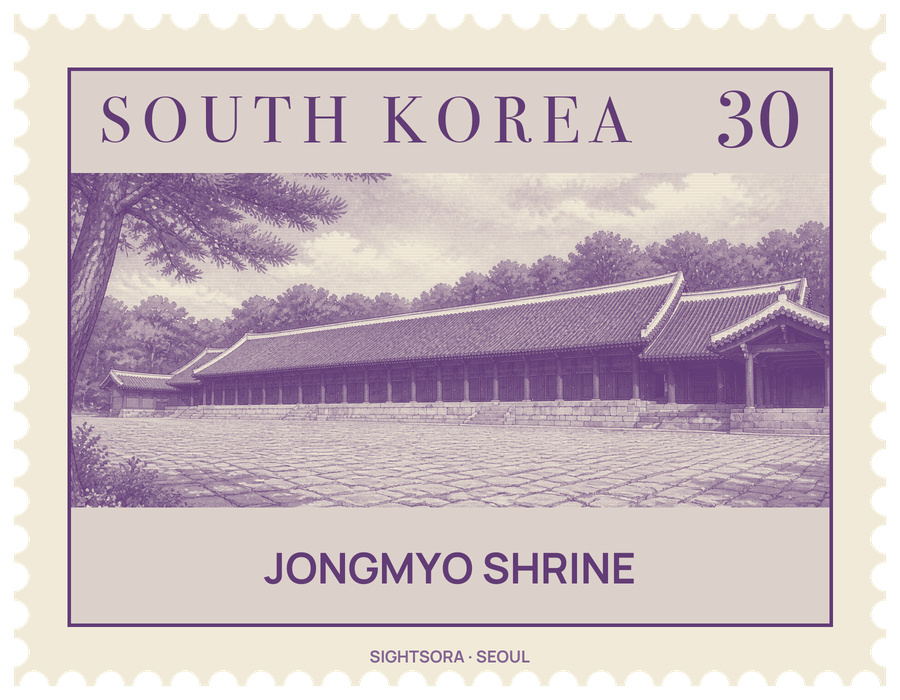
Taejo, founder and first king of Joseon, had its main buildings put up in October 1394, when he moved the capital to Hanseong, the city now called Seoul. UNESCO inscribed it as a World Heritage Site in 1995.
The complex grew from west to east as each reign added more tablets. The first main hall, Jeongjeon, began with seven niches, called myoshil, each holding the tablets of one king and his queens. King Sejong (r. 1418–50) added a second hall, Yeongnyeongjeon, the Hall of Eternal Comfort, and later kings kept extending the buildings. During the Japanese invasions of 1592–1598 the original shrine was burned, but the tablets survived because they had been hidden in a commoner's house; the complex that stands today was rebuilt in 1601.
Visitors see two great halls. Jeongjeon, a National Treasure, holds the tablets of 19 kings and 30 queens in 19 plain, undecorated niches, each tablet accompanied by a panel recording the king's achievements; Yeongnyeongjeon is the hall for kings whose line lay further back or whose reigns were short. A king's tablet was placed here only after the three-year mourning period that followed his death, and the most recent enshrinements, of Crown Prince Euimin and Crown Princess Bangja, took place in 1973 and 1991. In front of the main hall spreads the Woldae Courtyard, 150 metres long and 100 metres wide, and the halls are ringed by hills.
The layout follows ritual rather than convenience. Seen from the throne at Gyeongbokgung, Jongmyo lay to the king's left and the Sajik Shrine to his right, an arrangement taken from Chinese practice. Each gate had its own user: the south gate was kept for the spirits, the east gate for the king and the west gate for the performers of the royal ritual. Changdeokgung and Changgyeonggung lie just to the north; a road, Yulgok-ro, cut the shrine off from those palaces from 1932 until 2019, when it was put into a tunnel and the link between them was restored.
The shrine is still used for the Jongmyo Daejae, an ancestral ceremony in which descendants of the royal family honour their forebears; the Jeonju Lee Royal Family Association leads it today. It is accompanied by jongmyo jeryeak, the court music of Joseon with its dances, played by the Royal Court Orchestra; both the rite and the music are designated Intangible Cultural Heritage. The music traces back to Chinese court music brought to Korea in the Goryeo period, and King Sejong composed new pieces for the ritual in 1447 and 1462. Its songs call the ancestral spirits down from heaven to see what the kings achieved in founding and defending the country.