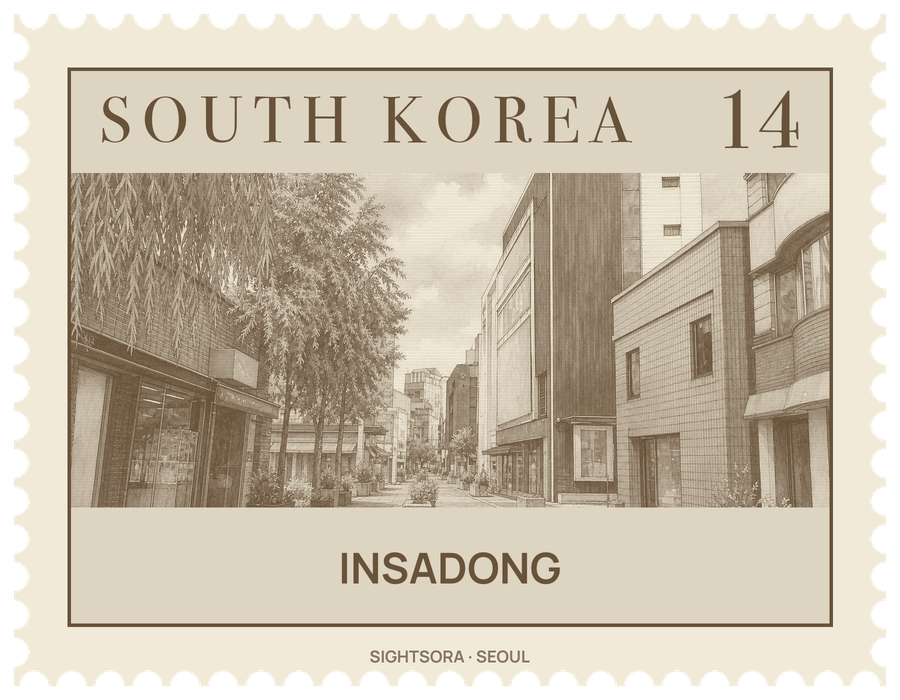
Historically this was where Korea's trade in antiques and artworks was centred. Many of the traditional buildings along the lanes belonged to merchants and officials, and a few larger houses built for retired Joseon officials survive; most of the old buildings are now restaurants and shops.
The district grew from two old wards, Gwanin-bang and Daesa-dong, whose names gave it the syllables In and Sa; a stream once divided them along the line of the present main street. For some 500 years it was a residential area for government officials. During the Japanese occupation the district's rich Korean families had to sell their possessions and leave, and the area turned to dealing in antiques. After the Korean War it became a centre of the country's art and café life, foreign visitors of the 1960s knew it as "Mary's Alley", and its fame with international tourists grew around the 1988 Seoul Olympics.
The shops are the main reason to come: antique dealers, galleries and traditional stationery stores selling hanji paper line the street, along with Tongmungwan, a long-established bookstore, and Kyung-in Art Gallery, a historic tea house. Calligraphy demonstrations and pansori performances take place in the area, and Ssamziegil, a mall of specialist handicraft shops, opened in 2004. Even the local Starbucks carries a sign in Korean script to suit the setting. Street snacks to look for include gimbap, odeng and bungeoppang.
Several historic buildings stand in or near the district: the mansion Unhyeongung, Jogyesa, one of the principal Korean Buddhist temples, Seungdong Presbyterian Church and the central temple of Cheondoism, completed in 1921; the Bosingak bell pavilion is close by as well. Information centres stand at the north and south entrances to the main street, and at the Insa P. R. Center opposite Ssamziegil visitors can try on hanbok, the traditional Korean dress.
Getting there
Three subway stations are within reach: Jonggak (Line 1), Jongno 3-ga (Lines 1, 3 and 5) and Anguk (Line 3).