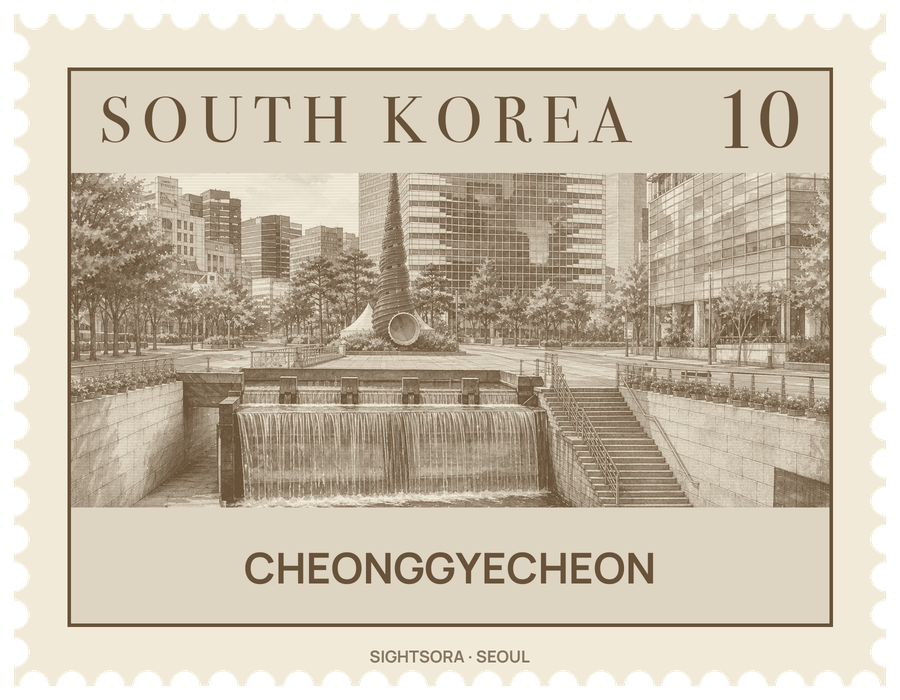
For decades it was hidden under concrete and an elevated expressway; since its reopening in September 2005 it has become a place where residents and tourists walk beside the water, past a mid-stream water feature and under bridges such as Mojeongyo.
Its course was managed long before the city grew around it. From 1406 King Taejong had the bed dredged and embankments built on both sides, and in December 1411 the government set up a temporary office, Gaecheondogam, to look after it; the stream was then known as Gaecheon, the "open stream", and King Yeongjo later made its upkeep a national project. It took its present name under Japanese rule. After the Korean War its banks filled with makeshift houses, and from 1958 the stream was covered over, a job that took 20 years; an elevated road 5.6 km long and 16 m wide opened above it in stages between 1969 and 1976.
In July 2003 Mayor Lee Myung-bak began removing the highway and bringing the stream back. Years of neglect had left it nearly dry, so 120,000 tons of water a day were to be pumped in, drawn from the Han River and its tributaries and from groundwater gathered in subway stations. How to restore the historic bridges Gwangtonggyo and Supyogyo was a hotly contested question. The change in the stream's life has been measured: between 2003 and the end of 2008 the number of plant species rose from 62 to 308, fish from 4 to 25 and birds from 6 to 36, and by the stream temperatures run 3.3 to 5.9 °C below those on a road parallel to it a few blocks away. In 2010 Harvard University's Graduate School of Design gave the restoration its Veronica Rudge Green Prize in Urban Design.