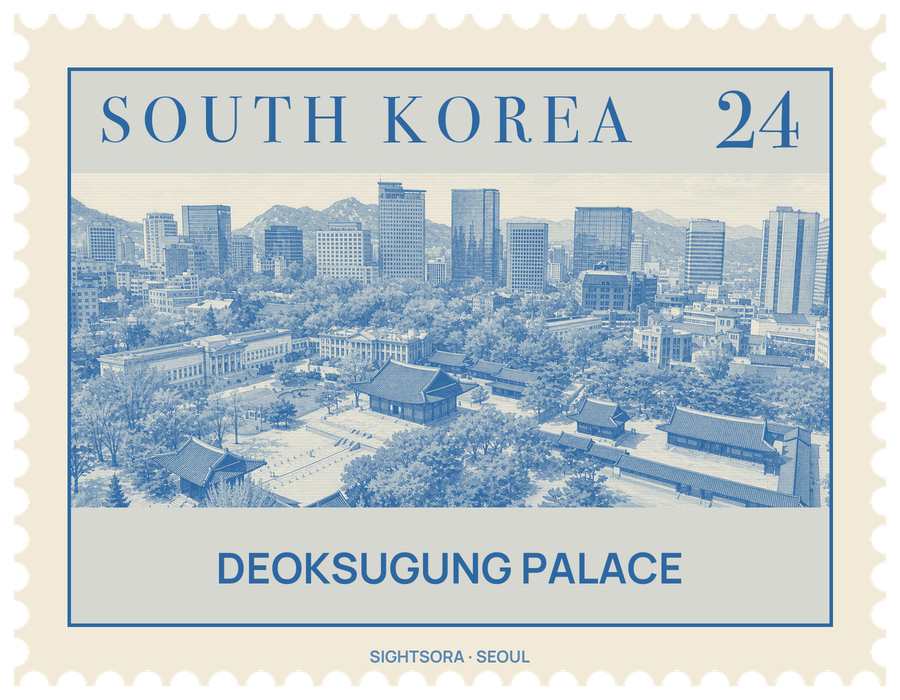
It was the main palace of the Korean Empire (1897–1910), and within its walls are the Daehan Empire History Museum and a Deoksugung branch of Korea's National Museum of Modern and Contemporary Art.
The site first served as a temporary palace for King Seonjo, who stayed here when he returned to Seoul in 1593 during the Imjin War, the other palaces having burned. It became a full palace in 1611, named Gyeongungung, but went largely unused for most of the later Joseon period. Its moment came after the 1895 assassination of Queen Min: Gojong chose it for its closeness to the foreign legations, moved in on February 20, 1897, and that October proclaimed the Korean Empire. He expanded the grounds, but a fire in 1904 destroyed most of the buildings, and he was forced to abdicate in 1907, the year the palace was renamed Deoksugung. He lived on here until his death in 1919. The colonial government then sold off and dismantled much of the property, turned it into a public park in 1933, and left only 8 of the original buildings; the palace today is around a third of its largest size, and efforts to bring back its pre-colonial look began in the 1980s.
The main gate, Daehanmun, on the east side, is decorated with dancheong and statues of beasts; it was moved inward twice during road widenings, the last time in 1970. In the east section stands Hamnyeongjeon, Gojong's sleeping quarters, where he died in 1919, rebuilt after the 1904 fire in an L-shape and heated by an ondol floor. Nearby, Jeonggwanheon is an American-style brick pavilion with a wooden porch, Romanesque columns on the veranda and Korean touches in its roof. In the centre, the gate Junghwamun leads to Junghwajeon, the main hall, rebuilt after the fire as a single storey with two dragons on its ceiling symbolising the emperor. Seogeodang, one of the few two-storey buildings left, is where Queen Inmok was confined in the 17th century, and its lower floor carries a signboard written by Gojong.
The west section is dominated by Seokjojeon, a neoclassical building designed and furnished by British people and completed in 1910, just months before Korea was annexed by Japan. Its interior was later altered, but efforts to restore its pre-colonial appearance led to the opening of the Daehan Empire History Museum inside it in 2014, while its West Wing of 1938 houses the art museum branch. A garden lies in front of both. Dondeokjeon, a French-style reception hall of 1902–1903 where Gojong received guests and Sunjong ascended the throne, was demolished in the 1920s; it has been rebuilt as a museum, open to the public since September 26, 2023.
Just outside the present walls, Jungmyeongjeon is the earliest Western-style building of the palace, a two-storey structure that first served as an imperial library. Gojong used it as his office after the 1904 fire, the Eulsa Treaty was signed here in 1905, and the wedding of Emperor Sunjong took place here in 1906. It has been managed as part of Deoksugung since 2007.