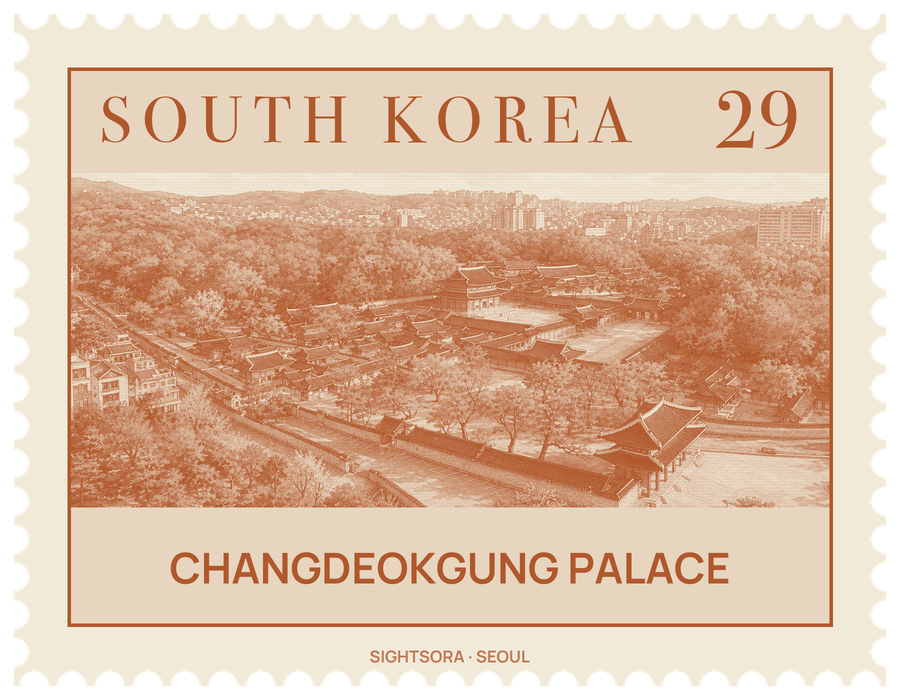
King Taejong ordered it built as a secondary palace, and the first phase was finished in 1405, making it the second palace of the Joseon capital after Gyeongbokgung. It was listed as a UNESCO World Heritage Site in 1997; the committee singled out the way its buildings are woven into the natural setting, adapted to the topography and keep the native tree cover.
Although Gyeongbokgung held the higher legal rank, most Joseon kings preferred to live here. In 1592, during the Imjin War, every palace in the city burned; afterwards money was short, so Changdeokgung and its neighbour Changgyeonggung were rebuilt while Gyeongbokgung was left in ruins, and for several centuries Changdeokgung served as the main palace. The royal family moved to Gyeongbokgung in 1868, but the last monarch, Sunjong, returned in 1907 and died here in 1926. During the colonial period after 1910 dozens of buildings were demolished, and in 1917 a fire destroyed the inner quarters. Some quarters, above all Nakseon-jae hall, stayed in use as a royal home until 1989, when Princess Deokhye and Crown Princess Bangja died.
The plan follows the Chinese ideal of three gates and three courtyards, moving from public to private: the first gate, Donhwamun, opened onto the area of government offices; the second, Jinseonmun, onto the court where the king dealt with his officials; and the third, Injeongmun, onto the quarters where the royal family lived. Unlike Gyeongbokgung, which runs south to north, Changdeokgung is laid out along a west to east axis. Within the grounds, the Geumcheongyo bridge, completed in 1411, crosses a now-dry stream on two arches; its balusters carry the Black Turtle-Snake guarding the north and the Bai Ze guarding the south, a Xiezhi stands on each of its four newels, and a dokkaebi goblin is carved on both sides. Mulberry trees grow around the grounds, possibly a reminder of the queens who raised silkworms here.
Behind the palace lies the rear garden, Huwon, better known as the Secret Garden, which Changdeokgung shares with Changgyeonggung. Kings used it for leisure, hunting and parties, but also for ceremonies, military drills and state examinations, and before the 20th century most people were barred from it. The ground rises to its highest point in the middle and falls away to east and west, with artificial ponds and pavilions among more than 160 species of trees, over 70 of them more than 300 years old. In the north, the Jade Stream, Ongnyucheon, created in 1636, runs past Soyojeong, Taegeukjeong and Cheonguijeong, known together as the Three Pavilions of the Royal Grove; this area was closed in 1979 to protect its ecology and reopened in 2004.